Author: Darren Enns

  • Can Crappie Be Used as Bait?

    Can Crappie Be Used as Bait?

    Can You actually use crappie as bait?

    Yes – But there’s a couple of catches. I’ve caught and handled plenty of crappie over the years, and while I’d rather put one on the dinner table or just release it, crappie can make effective cutbait prl larger fisg like catfish and others. Before you do it though, check your states regulations because using gamefish for bait isn’t legal everywhere.

    Ask anyone who has been out on the fishing shores and lakes for any length of time, and they will tell you that there are certain topics, even among anglers, that are just controversial. For example, some believe that you should never kill what you catch; you should always throw it back, or vice-versa.

    There are some who believe that it is better to use artificial baits, while there are still others who think that live baits are better. That brings us to our topic, which is whether crappie can be used as bait. I thought you were only supposed to either eat the crappie or simply throw it back! Well, no, there’s actually a growing consensus of fishermen that are starting to use the CRAPPIE THEMSELVES as bait.

    Can Crappie be used as bait? Any fish including crappie can be used as cut-bait for fishing. Usually the oilier the cut bait is, makes it more preferred as fish bait and there are definitely much oilier fish than crappie. Also, many anglers choose to eat the crappie instead of using them as bait because they are one of the tastiest. Keep in mind that some state laws prohibit using sportfish as bait.

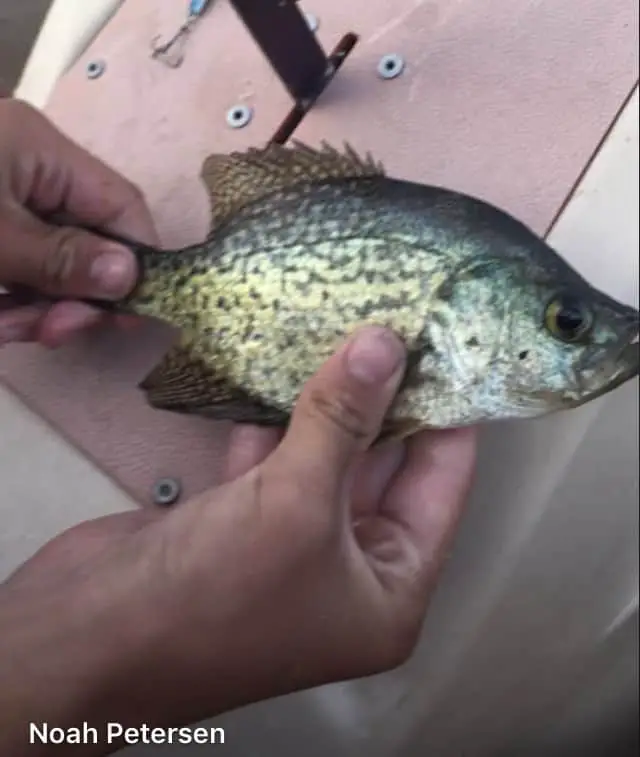
    Noah Petersen With his Black Crappie

    Should Crappie Be Used as Bait?

    Of course, when you start talking to anglers about using crappie as bait, you are liable to get ten different opinions on the subject. However, one of the things you will quickly realize after you “bite the bullet” and decide to try using crappie for bait instead of eating it is that this breed of fish can be incredibly nifty for catching the predator fish that feed on crappie.

    Of course, do get ready for some rough comments. Some will say that you are simply wasting good crappie if you just use it for bait. Just ignore the naysayers, though, because crappie will make an excellent baitfish when needed, that is for sure!

    Here are some good hooks for crappie fishing. size 8-12 are great!

    The finnish J. Martin Filet Knife has been s favorite for anglers for many years. I have used one nearly my whole life. you can find this must have filet knife HERE on Amazon.

    Naturally, if you are going to go with crappie simply as baitfish, you have to make sure that you know what you are doing. The best way to do this would be to manufacture the crappie into cut bait. The name for this kind of bait is pretty self-explanatory; it simply means that you are going to cut up a given fish and use it for bait for another fish.

    If you want to catch a larger predatory fish, this is really the ticket, no ifs, and, or buts. In fact, a larger catfish species such as a blue catfish will usually jump at the chance for you to use any type of cut bait, including that of crappie bait.

    Need CHUM ? Here’s an article you might like about chum for crappie.

    Of course, there is a broad cross-section of anglers that will still scoff over crappie being used as cut bait, but simply ignore them. At the same time, there is actually a growing number of people who are starting to realize that it is useful for bait as well.

    Of course, the next time someone makes fun of you for thinking about using crappie as cut bait, just use this wrinkle on them: if we, as humans, find the taste of crappie, how much more do you think that other larger fish might find them delicious as well!

    Hey FISHMONGER – make sure to check out my FISHING RESOURCES page.

    Be Mindful of the Local Laws

    Of course, an added benefit to your decision of using crappie as bait is that you also get the added enjoyment of catching the bait as well as catching more fish! However, you definitely will need to be mindful of the local laws regarding your crappie bait.

    First of all, just because you are only going to use your crappie as bait is not going to sway the opinion of any local game warden. That is, whatever you might use your crappie for, you will still have daily catch limits of crappie in many jurisdictions.

    Moreover, are you going out of state to catch your crappie? If so, make sure that you do a little bit of research. Some states are stricter than your own state when it comes to crappie and what you can use them for. Check these laws just to be sure.

    Which Fish Should You Go After?

    Of course, the dominant elephant in the room would have to be just what types of fish you can catch with crappie bait. Either way, you will soon find out that crappie is a fish breed that isn’t just popular among humans, but also larger fish! Indeed, there are quite a few predatory species that love to dine on crappie. Some of these would include a broad cross-section of freshwater fish, including the following:

    • Largemouth Bass
    • Channel Catfish
    • Striped Bass
    • Blue Catfish
    • Flathead Catfish
    • Crappie
    • Sunfish
    • Smallmouth bass

    How Do I Go About Preparing Crappie as Cut Bait?

    The size of this chunk of bait will not only depend on the size of the crappie you have landed, but also on the size of the type of fish that you are targeting. For example, if you are targeting a larger species of fish, you will naturally want to cut up larger portions of your crappie.

    Of course, if you are targeting blue catfish, you probably could get away with using a smaller chunk of crappie just because this type of catfish isn’t that much larger than the crappie, anyway.

    Generally, a good rule of thumb is that if you are trying to land a fish that is in the trophy class, you might want to strongly consider a larger chunk of crappie bait. However, this isn’t a hard-and-fast rule. Indeed, don’t think for a minute that a larger fish wouldn’t go after a smaller piece of crappie bait. They definitely will, but at the end of the day using larger baits is often just a matter of personal preference.

    More about keeping worms alive after your fishing trip – what do fishing worms eat?

    Follow The Steps

    Once you got that basic knowledge out of the way, you should be aware of some of the steps to preparing crappie for bait right. The first step is to remove the scales.

    Now, there are two different approaches to doing this. For the larger examples of crappie, you probably should remove them by simply starting at the tail and removing them simply by just vigorously running your thumb over the scales until they fall off. Alternately, if this is smaller crappie, you could simply just use a fillet knife to knock those scales off.

    Next, you should make sure you remove the scales and cut off the fins. Finally, after you have retrieved the chunk you have used for bait, there is one cardinal rule: always leave it EXACTLY the way you got it from the fish. Leaving it unwashed makes it extremely more likely to catch a fish because there is more oil, blood, and other amino acids that will attract a predator fish.

    Keeping this in mind will make your crappie bait experience a very enriching one indeed!


    Darren Enns Author is a father of four boys. Trout, Striper, Catfish, and bluegill are their favorite fish to catch. I would rather eat Crappie than use it as bait.

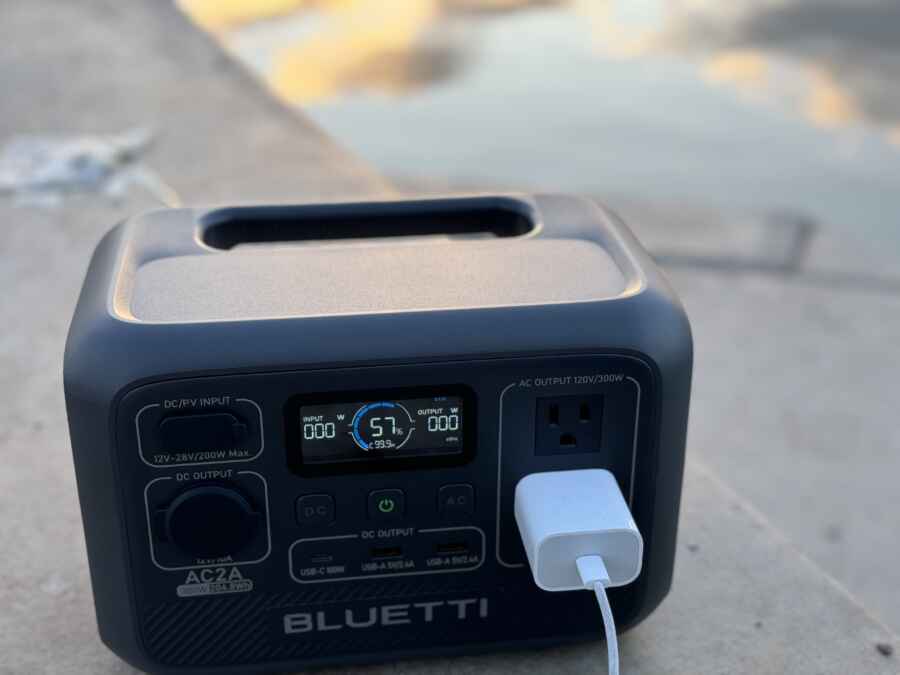
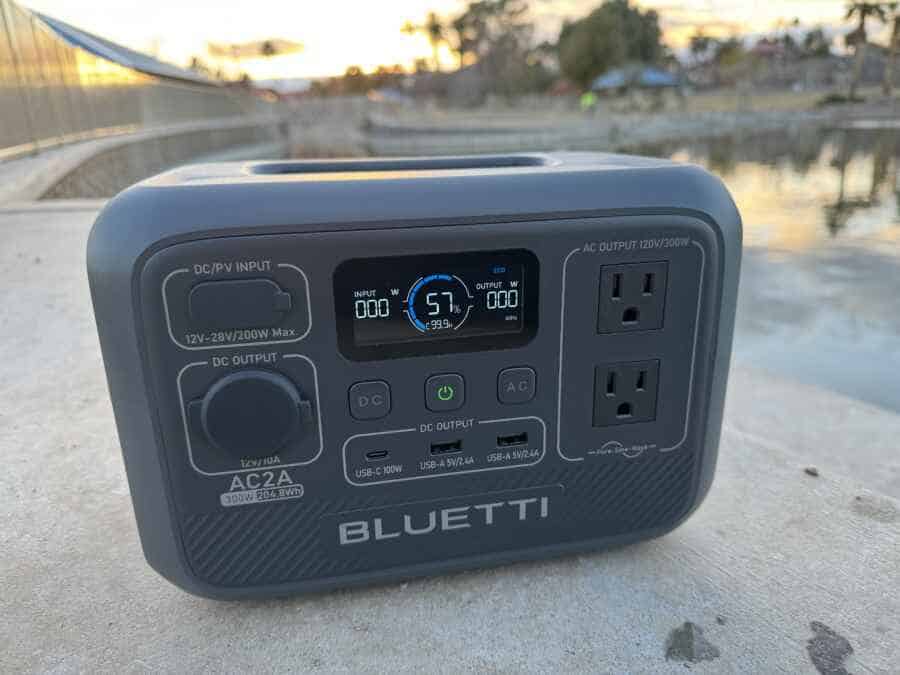
  • Bluetti Power Station -Awesome! (BLUETTI AC2A Portable Power Station)

    Unleashing Power for Anglers

    Hey there, friends. Today I’m going to let you know one of the best pieces of technology I take with me when I go fishing and for good reason! 

    If you’re like me and my four sons, hitting the waters around Las Vegas – be it the Colorado River, Lake Mead, or other local gems – is more than just a pastime; it’s a way of life. And in the pursuit of our angling adventures, we stumbled upon a game-changer that not only keeps our devices juiced up but adds a new dimension to our fishing.  – the Bluetti Power Station. BLUETTI AC2A Portable Power Station

    Power to Keep the Adventure going. (BLUETTI AC2A Portable Power Station)

    PS: at the end of this, I’m going to give you a comparison between 6 different power stations.

    One of the standout features of the Bluetti Power Station is its 300W AC output and 600W lifting power. For us, this means no more worrying about drained batteries on our fishing essentials. For example – charging our phones to capture the triumphant moment of landing a bass or powering up flashlights for those early morning expeditions, Bluetti’s got our back. (it’s always a bummer when we’re recording video and our phones are getting ready to die. It’s nice to know if we can charge them back up when that happens.)

    Extended Battery Life for Endless Fishing Thrills

    With a hefty 204.8Wh capacity, the Bluetti Power Station ensures that the adventure doesn’t stop until we are ready for it to stop. It’s like having an extra boost of energy for those long days out on the water. We’ve found it particularly handy when targeting different species – from trout to striper, catfish, and bass. This power hub keeps our devices alive, allowing us to document every catch and share our fishing chronicles with the world. (Thank you for reading by the way.)

    Rapid Charging for On-the-Go Anglers (BLUETTI AC2A Portable Power Station)

    Time is of the essence in fishing, and waiting for gadgets to charge can be a real buzzkill. Bluetti’s 270W turbo charging comes to the rescue, giving us an 80% charge in just 45 minutes. That means less downtime and more time doing what we love – casting lines and reeling in memories. Oh and don’t for get reeling in fish too. 

    Built to Endure: LiFePO₄ Battery Technology

    Fishing adventures can be demanding, and our gear needs to stand up to the challenge. The Bluetti Power Station boasts LiFePO₄ battery technology, designed for over 3,000 charge cycles. It’s like having a reliable fishing buddy that never lets you down, trip after trip.

    Whisper-Quiet Operation: Let the Fish, Not the Noise, Be the Focus

    Ever had a noisy generator scare away potential catches? With Bluetti, we enjoy quiet operation at less than 45dB. Now, the only ripples disturbing the water are caused by our well-placed casts, not the humming of a loud power source. It adds a level of tranquility to our fishing spots, letting us connect with nature without unnecessary disturbances.

    Control at Your Fingertips: Smart Remote Access via Bluetti App 

    Managing power settings has never been easier. The Bluetti app provides smart remote control, allowing us to tweak settings from our phones. It’s like having a high-tech fishing assistant, ensuring our power needs are met without leaving the comfort of our fishing spot.

    5b84daa87b34d6bb885add40a10ef9fa.png

    Elevating the Fishing Experience with Bluetti

    Versatility Beyond Charging:

    A Multifunctional Marvel

    Bluetti isn’t just about charging devices; it’s a multifunctional marvel that enhances our overall fishing experience. 

    During hot days, we use it to power fans, creating a cool oasis. The convenience of having a portable power station that caters to various needs amplifies our enjoyment on the water. It’s not just a tool; it’s become an integral part of our angling arsenal.

    Bluetti is tuff enough to last:

    Ready for the Rigors of the Outdoors

    Fishing takes us to diverse environments – from serene lakes to rugged riverbanks. The Bluetti Power Station’s robust build is designed to withstand the rigors of the outdoors. Whether it’s enduring splashes from an unexpected wave or handling the bumps and jostles of a rocky terrain, this power station stands tall, undeterred by the challenges of our angling escapades. It’s not uncommon to see us throw one in our wagon and drag it over the bumpy road or through the dirt until we get to the shore where we are going to fish. It also sometimes sits in the hot truck for hours at a time, but it keeps on working and we are so glad we have it.

    Compact and Portable: 

    The Perfect Fishing Companion

    Despite its powerful capabilities, the Bluetti Power Station remains impressively compact and portable. Its sleek design allows us to stow it in with our fishing gear effortlessly. The compact form factor doesn’t compromise on functionality, making it a must have that seamlessly integrates into our fishing routine.

    An Angler’s Perspective:

     The Sling on Bluetti

    As anglers, we appreciate gear that understands our needs. The Bluetti Power Station goes beyond being a practical device; it becomes a trusty sidekick, akin to a well-worn fishing hat or a favorite rod. We’ve affectionately named it our “power sling,” as it slings power to our devices with unparalleled reliability.

    Setting the Scene: 

    How Bluetti Enhances Night Fishing

    Night fishing is a cherished activity for us, but the lack of light can pose challenges. Bluetti steps in as our beacon in the dark. With charged-up flashlights and portable lamps, we transform the night into an extended fishing session.

    The Bluetti Effect: Sharing the Adventure Online

    In the age of social media, our fishing adventures are not just for us but for our online fishing community. The Bluetti Power Station plays a pivotal role in this digital sharing experience. Its reliable charging ensures that we can capture and share every moment, from the anticipation of a big catch to the camaraderie among family members on the boat. Our fishing tales are now amplified, reaching fellow anglers and inspiring new fishing enthusiasts to explore the great outdoors.

    I hope you find these additions helpful! If you have any specific areas you’d like me to delve into or if you have particular aspects you’d like me to emphasize, feel free to let me know. – Darren 

    and now, for the comparison that I promised in the beginning. Here you go I hope this helps.

    Bluetti AC2A

    1. Battery Capacity: 204.8Wh
    2. Power Output: 300W continuous, 600W surge
    3. Battery Type: LiFePO4 (Lithium Iron Phosphate)
    4. Weight: 3.6kg (7.9 lbs)
    5. Dimensions: 9.8 x 5.9 x 7 inches
    6. Charging Time: 45 minutes to 80% with 270W Turbo Charging
    7. Outputs: 2x AC outlets, 1x 100W USB-C, 2x USB-A, 1x 12V car port
    8. Inputs: AC, DC (solar)
    9. Durability: Robust construction with a sturdy handle
    10. Special Features: Pure sine wave inverter, eco-friendly solar charging, built-in LCD​ (Greener Ideal)​​ (The Gadgeteer)​​ (The Bushwalking Blog)​.

    Jackery Explorer 240

    1. Battery Capacity: 240Wh
    2. Power Output: 200W continuous, 400W surge
    3. Battery Type: Lithium-ion
    4. Weight: 3.1kg (6.6 lbs)
    5. Dimensions: 9 x 7.8 x 5.2 inches
    6. Charging Time: 7-8 hours (AC), 9-10 hours (solar)
    7. Outputs: 1x AC outlet, 2x USB-A, 1x 12V car port
    8. Inputs: AC, DC (solar)
    9. Durability: Solid build with integrated handle
    10. Special Features: MPPT controller for efficient solar charging, LED flashlight​ (The Gadgeteer)​.

    Anker Powerhouse 200

    1. Battery Capacity: 213Wh
    2. Power Output: 200W continuous, 400W surge
    3. Battery Type: Lithium-ion
    4. Weight: 3.5kg (7.7 lbs)
    5. Dimensions: 7.48 x 5.47 x 4.69 inches
    6. Charging Time: 6-7 hours (AC), 8-9 hours (solar)
    7. Outputs: 1x AC outlet, 1x USB-C, 2x USB-A, 1x 12V car port
    8. Inputs: AC, DC (solar)
    9. Durability: Rugged design with rubber bumpers
    10. Special Features: Fast-charging USB-C, compact and portable design​ (The Gadgeteer)​.

    EcoFlow River 600

    1. Battery Capacity: 288Wh
    2. Power Output: 600W continuous, 1200W surge
    3. Battery Type: Lithium-ion
    4. Weight: 5kg (11 lbs)
    5. Dimensions: 11.3 x 7.3 x 7.7 inches
    6. Charging Time: 1.6 hours (AC), 3-6 hours (solar)
    7. Outputs: 3x AC outlets, 1x 100W USB-C, 2x USB-A, 1x 12V car port
    8. Inputs: AC, DC (solar)
    9. Durability: Durable build with solid handle
    10. Special Features: X-Boost technology for high-wattage devices, modular design for battery expansion​ (Greener Ideal)​.

    Goal Zero Yeti 200X

    1. Battery Capacity: 187Wh
    2. Power Output: 120W continuous, 200W surge
    3. Battery Type: Lithium-ion
    4. Weight: 2.27kg (5 lbs)
    5. Dimensions: 7.9 x 5.1 x 5.1 inches
    6. Charging Time: 4 hours (AC), 8-10 hours (solar)
    7. Outputs: 1x AC outlet, 1x USB-C PD, 2x USB-A, 1x 12V car port
    8. Inputs: AC, DC (solar)
    9. Durability: Lightweight and compact design
    10. Special Features: Pass-through charging, integrated MPPT controller​ (StorageReview.com)​.

    Rockpals 300W

    1. Battery Capacity: 280Wh
    2. Power Output: 300W continuous, 600W surge
    3. Battery Type: Lithium-ion
    4. Weight: 3.5kg (7.7 lbs)
    5. Dimensions: 10.5 x 5.9 x 10.2 inches
    6. Charging Time: 6-7 hours (AC), 8-9 hours (solar)
    7. Outputs: 1x AC outlet, 1x USB-C, 3x USB-A, 1x 12V car port
    8. Inputs: AC, DC (solar)
    9. Durability: Sturdy with a handle for easy carrying
    10. Special Features: MPPT technology, multiple output options, compact design​ (KenRockwell)​.
  • Best Fishing Reel Brands

    Fishing is one of the most popular outdoor activities in the world, and having the right fishing reel can make all the difference in the success of a fishing trip. With so many different fishing reel brands on the market, it can be overwhelming to choose the best one for your needs. In this article, we will explore some of the top fishing reel brands and what sets them apart.

    One of the most well-known fishing reel brands is Shimano. Shimano has been making fishing reels for over 80 years and is known for its high-quality reels that are designed to last. Shimano reels are built with durable materials, including metal frames and gears, and they are designed to handle heavy loads and long fishing trips. Some of the most popular Shimano reels include the Shimano Stradic Ci4+, the Shimano Saragosa, and the Shimano Stella.

    Another top fishing reel brand is Penn. Penn has been making fishing reels since 1932 and is known for its high-quality, reliable reels that are built to last. Penn reels are made with corrosion-resistant materials, making them ideal for use in saltwater environments. Some of the most popular Penn reels include the Penn Spinfisher VI, the Penn Battle II, and the Penn Slammer III.

    Abu Garcia is another well-known fishing reel brand that has been around since 1921. Abu Garcia is known for its innovative designs and technologies, including the Rocket Line Management System and the Carbon Matrix Drag System. Abu Garcia reels are designed to be lightweight and easy to handle, while still providing plenty of power and precision. Some of the most popular Abu Garcia reels include the Abu Garcia Revo SX, the Abu Garcia Revo Toro Beast, and the Abu Garcia Ambassadeur.

    Daiwa is another top fishing reel brand that has been making reels since 1955. Daiwa reels are known for their smooth performance and innovative technologies, including the Magsealed system that keeps out water and dirt. Daiwa reels are also designed to be lightweight and easy to handle, making them ideal for long fishing trips. Some of the most popular Daiwa reels include the Daiwa Tatula, the Daiwa Saltiga, and the Daiwa BG.

    Finally, Okuma is another top fishing reel brand that is known for its affordable, high-quality reels. Okuma reels are designed to provide plenty of power and precision, while still being lightweight and easy to handle. Okuma reels are also built with durable materials, making them ideal for use in saltwater environments. Some of the most popular Okuma reels include the Okuma Cedros CJ-65S, the Okuma Azores Z-65S, and the Okuma Avenger ABF.

    So, there are many different fishing reel brands on the market, each with its own unique strengths and features. Whether you are looking for a high-quality, reliable reel for saltwater fishing or a lightweight and easy-to-handle reel for freshwater fishing, there is a brand out there that is perfect for your needs. Shimano, Penn, Abu Garcia, Daiwa, and Okuma are all top fishing reel brands that are worth considering when looking for a new reel. Ultimately, the best fishing reel for you will depend on your specific needs and preferences, so it is important to do your research and choose a reel that will help you have the best fishing experience possible.

    darrenopcmia@gmail.com

    Saltwater Reels: Key Features to Look For When Choosing Your Next Reel

    Corrosion Resistance: Saltwater is highly corrosive, and if your reel is not made with materials that can withstand saltwater exposure, it will quickly become damaged and lose functionality. Look for reels with high-quality materials, such as stainless steel, titanium, or anodized aluminum, that are specifically designed to resist saltwater corrosion.

    1. Drag System: The drag system is one of the most important features to consider when choosing a saltwater reel. It’s what allows you to control the tension on the line as you fight the fish. Make sure the drag system is strong and smooth, and can handle the weight of the fish you’re targeting. A good drag system will help prevent line breakage and allow you to tire out the fish more easily.
    2. Gear Ratio: The gear ratio determines how quickly the reel retrieves the line. A higher gear ratio means faster retrieval, which can be helpful when you need to quickly reel in your catch or when fishing in strong currents. However, a lower gear ratio can provide more power when fighting larger fish, so it’s important to choose a gear ratio that matches the type of fish you’re targeting.
    3. Line Capacity: Make sure the reel you choose has enough line capacity to handle the type of fishing you plan to do. This is especially important when targeting larger species that may require longer and heavier lines.
    4. Handle: The handle is what you’ll use to retrieve the line, so it’s important to choose one that feels comfortable and is easy to grip. Look for handles that are ergonomically designed and have a non-slip grip to ensure you can maintain control, even when your hands are wet.
    5. Size and Weight: The size and weight of the reel will affect how comfortable it is to use, especially if you plan to fish for extended periods. Make sure the reel you choose is a comfortable size and weight for your needs, without sacrificing durability and performance.

    Saltwater Reels: Key Features to Look For When Choosing Your Next Reel
    Saltwater fishing requires specialized equipment, and selecting the right reel is crucial to ensure a successful and enjoyable fishing experience. With so many different types and brands of saltwater reels available, it can be overwhelming to choose the best one for your needs. In this article, we’ll discuss some key features to consider when selecting your next saltwater fishing reel.

    In summary, when choosing a saltwater reel, it’s important to consider features such as corrosion resistance, drag system, gear ratio, line capacity, handle, size, and weight. By taking these factors into account, you can select a reel that will help you achieve success on the water and provide a satisfying fishing experience.

    darrenopcmia@gmail.com

    Best Fishing Reels for Every Budget: Finding Your Perfect Match.

    Fishing is an excellent way to relax, unwind and enjoy the outdoors. However, finding the perfect fishing reel can be challenging, especially if you’re on a budget. Fortunately, there are many quality fishing reels available that won’t break the bank. Here are some of the best fishing reels for every budget.

    Firstly, for those on a tight budget, the KastKing Summer Spinning Reel is an excellent option. This reel is perfect for beginners and offers excellent value for money. It features a lightweight design, durable construction, and smooth operation, making it easy to use and perfect for catching smaller fish.

    For those looking for a mid-range option, the Shimano Stradic Ci4+ FB Spinning Reel is a top choice. It features a carbon fiber body, rotor, and side plate, which make it incredibly lightweight and durable. It also has an impressive drag system and is suitable for catching larger fish. The Shimano Stradic Ci4+ FB Spinning Reel is an excellent choice for anglers who want a reliable, high-quality reel without breaking the bank.

    If you’re looking to spend a little more, the Penn Battle II Spinning Reel is a great option. It features a full metal body, side plate, and rotor, which make it incredibly strong and durable. It also has a smooth drag system and is suitable for catching large saltwater fish. The Penn Battle II Spinning Reel is an excellent choice for anglers who want a high-quality reel that can handle even the toughest conditions.

    For those with a larger budget, the Shimano Stella FI Spinning Reel is an excellent choice. It features a magnesium body and rotor, which make it incredibly lightweight and durable. It also has an impressive drag system and is suitable for catching larger fish. The Shimano Stella FI Spinning Reel is one of the best spinning reels on the market, and it’s an excellent choice for experienced anglers who want the best of the best.

    Another great option for those with a larger budget is the Abu Garcia Revo SX Baitcasting Reel. This reel is perfect for catching larger fish and features a durable, corrosion-resistant design. It also has a smooth, reliable drag system and is easy to use. The Abu Garcia Revo SX Baitcasting Reel is an excellent choice for anglers who want a high-quality, reliable reel that can handle even the toughest conditions.

    Finally, there are many great fishing reels available for every budget. Whether you’re a beginner or an experienced angler, there’s a reel out there that’s perfect for you. When choosing a fishing reel, it’s essential to consider your budget, the type of fish you want to catch, and the conditions you’ll be fishing in. By doing so, you’ll be able to find the perfect fishing reel for your needs and enjoy a great day out on the water.

    darrenopcmia@gmail.com

    Conventional Reels vs. Spinning Reels: Which Is Right for You?

    When it comes to choosing a fishing reel, one of the biggest decisions you’ll need to make is whether to go with a conventional reel or a spinning reel. Both have their advantages and disadvantages, and the right choice for you will depend on your fishing style, target species, and personal preference.

    Conventional reels, also known as baitcasting reels, are known for their accuracy and power. They are ideal for catching larger fish species and can handle heavy lines and lures with ease. Conventional reels have a spool that rotates perpendicular to the rod, and the line comes off the spool in a straight line. This allows for greater casting accuracy and control, especially when casting heavy lures into the wind. Conventional reels are also great for fishing in deep waters, as they have a high line capacity and can handle the weight of heavy sinkers.

    However, conventional reels require a bit of skill to use effectively. They are more difficult to cast than spinning reels, and a backlash can occur if you don’t have the proper technique. This can lead to tangles and frustration on the water. Additionally, conventional reels can be more expensive than spinning reels, making them less accessible for anglers on a budget.

    Spinning reels, on the other hand, are known for their ease of use and versatility. They are great for catching smaller fish species and are ideal for beginners or those who prefer a more relaxed fishing experience. Spinning reels have a spool that is fixed in place, and the line comes off the spool in a circular motion. This allows for easier casting and reduces the risk of backlash. Spinning reels are also great for fishing in shallow waters or areas with a lot of vegetation, as they can handle lighter lines and lures.

    Spinning reels are generally more affordable than conventional reels, making them a popular choice among budget-conscious anglers. However, they do have some limitations. They are not as powerful as conventional reels and may struggle to handle heavy lines or lures. Additionally, they can be less accurate when casting in windy conditions, as the line may be affected by the wind and not travel in a straight line.

    In the end, the choice between a conventional reel and a spinning reel will depend on your personal preference and fishing style. If you’re looking to catch larger fish species or want more accuracy and power, a conventional reel may be the way to go. If you’re a beginner or prefer a more relaxed fishing experience, a spinning reel may be the better choice.

    When choosing a reel, be sure to consider the features that are important to you, such as line capacity, drag system, and gear ratio. Both conventional and spinning reels come in a variety of sizes and styles to suit different fishing needs, so take the time to research and compare options before making a decision. With the right reel in hand, you’ll be able to enjoy a successful and enjoyable day on the water, no matter what type of fishing you prefer.

  • Best bait shop in Orlando (live Bait / Custom Plastics)

    Best bait shop in Orlando (live Bait / Custom Plastics)

    If you are taking a trip to Orlando, Florida for a huge fishing trip, then I am going to offer you some spectacular information. This will help you in catching a lot of fish, having a superb time, and going home with a ton of stories to tell. I have found the best bait and tackle shop in the Orlando, Florida area. They offer hundreds of hand-made, custom baits for catching fish on all of the Florida lakes. The owner of this particular bait and tackle store is also a United States Coast Guard certified fishing guide. Captain Tim Bagwell knows all there is to know about the lakes and fishing in Florida. https://floridabasscharter.com/

    Get Hooked Bait and Tackle

    Where can I buy bait in Orlando?

    Get Hooked Magic Baits is the premier place to get all of the bait and tackle that you will need to be successful while fishing in Florida. Tim’s website (www.gethookedmagicbaits.com) offers any kind of bait and tackle that you can imagine. All the baits are custom-made and used all over the United States for outstanding fishing. Whether you are a beginner, a pro, young, or old Get Hooked Magic Baits has everything you need for a fantastic fishing trip, no matter where you are. (Captain Bagwell says It’s not about the baits it’s about the magic.)

    Let’s take a gander at the website and give you all of the best information possible, including all of the contact information that you need, in case you have any questions or concerns. Get Hooked Bait & Tackle is the go-to bait and tackle shop in the Orlando area.

    Best Bait Shop in Orlando – Get Hooked Bait & Tackle

    If you are in the Orlando area and you are looking for the best tackle possible for fishing the Florida waters, please stop in at 358 Story Road Suite A in Ocoee, Florida. The staff atGet Hooked Bait & Tackle will help you find everything that you need to make your fishing trip successful. Whether you live in Florida or you are there on vacation, stop in and see Captain Tim and his extremely knowledgeable staff.

    plastic baits
    My Recomendation-click

    Best Bass Baitshop Website

    If you are wanting to take a look at everything they have to offer, before you get to Florida or to use in your own lakes then take a look at their spectacular website www.gethookedmagicbaits.com It is extremely user friendly and organized. They have thousands of items to choose from in a vast array of shapes, sizes, and colors. You can do a ‘search for a particular product or you can browse one of their many categories; flukes, worms, frogs, jerk baits, and trick worms just to name a few. They also have rods, reels, combos (in-store), and everything else you need for a spectacular fishing trip

    If you can not find something that you are looking for, feel free to email gethookedmagicbaits@gmail.com or give them a call at 1-407-347-3072. Tim and his amazing staff will be more than happy to help you with any questions that you have. Also available on their website is Get Hooked merchandise and terminal tackle. You can also visit their other website www.gethookedbaitandtackle.com Not only do they have all the fishing equipment that you need for your fishing trip in Florida, they also offer Bass Fishing Guide Trips. Check it out and book your trip today.

    Where can I buy live bait in Orlando?

    Tim and his crew offer live bait all year round at Get Hooked Bait & Tackle. It is actually some of the best live bait in the state of Florida. Choose from crickets, minnows, shiners, wild shiners, and worms. At Get Hooked Magic Baits they have all of your must-have fishing supplies. They also have buckets and aerators for the live bait. They have forgotten not a single thing that you will need for an amazing fishing trip in Florida.

    Get Hooked Magic Baits has every type of bait you will need to catch every type of fish that roams the waters in Florida. They can provide advice on the best spots to fish, the best times of day to go fishing, and they can answer any other questions that you may have. You can follow Tim and his crew on Facebookhttps://www.facebook.com/gethooked.baitandtackle or https://www.facebook.com/GHMBwork

    lake harris

    Check out their blog from either website www.gethookedmagicbaits.com or www.gethookedbaitandtackle.com You can also see photos and videos of their catches … using the Get Hooked Magic Baits very own custom baits. Everything you need and everything you need to know about fishing in Florida can be purchased and answered by Captain Tim and his staff. Browse their website and you will see for yourself. Their baits are popular all over the United States, no matter where you are going to be fishing their baits will get you what you want.

    Conclusion

    Captain Tim Bagwell and his team are extremely knowledgeable about all things fishing in the Orlando, Florida area. His bait and tackle shop Get Hooked Bait & Tackle has thousands of options to choose from. They sell and ship all over the United States. Check out the website www.gethookedmagicbaits.com and see for yourself, all of the ‘magic’ that Tim has to offer, whether you are fishing in Florida or fishing ‘in your own backyard.’

  • Are Striped Bass Good To Eat? (The delicious secret)

    Are Striped Bass Good To Eat? (The delicious secret)

    There is a long list of freshwater fish that are great to feast on. Walleye, perch, crappie, and catfish just to name a few. There are also many ways that you can prepare fresh caught (or store bought) striped bass; roast, grill, and bake are the most popular. Most anglers know the best fish to eat and the best ways to prepare them. What if you are not as experienced? Well, that is what I am here for.

    Are striped bass good to eat? Striped bass, also known as striper or rockfish; are healthy, versatile, and delicious. You can cook them on the grill, in a skillet, in the oven, or even in the broiler. Striped bass is a meatier fish that has a natural sweetness and is flavorful. No matter how you choose to prepare your striped bass, it is going to be an amazing meal.

    Let’s answer a few more of your questions about striped bass, preparing, and nutrition. Be prepared to want to go out and catch some striped bass for your next meal.

    Fishing for striped bass
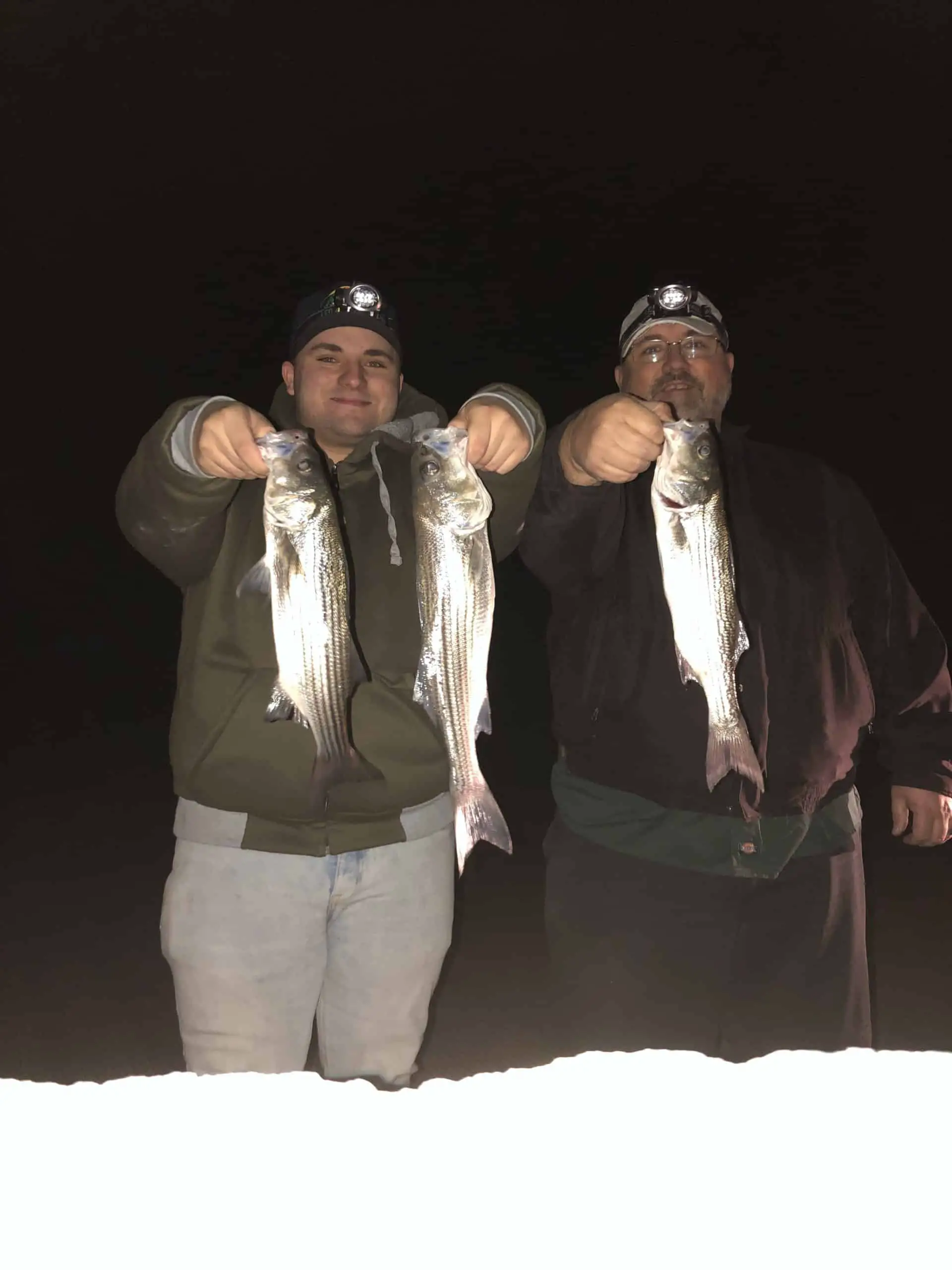
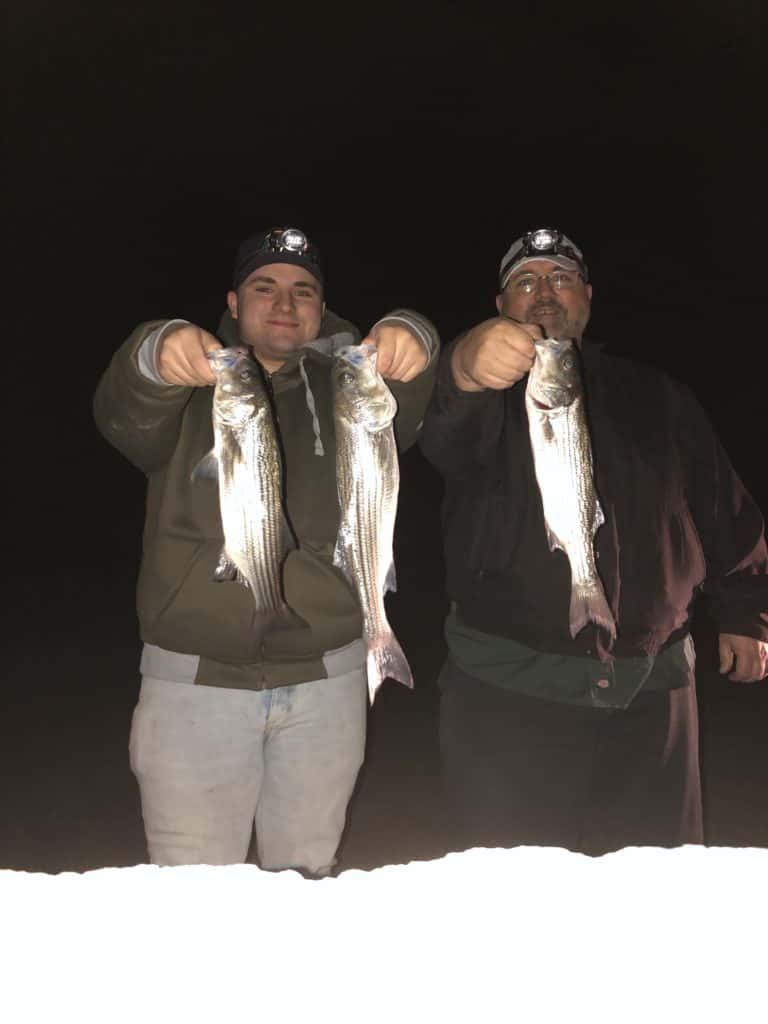
    My son Sheldon and I with some Lake Striped Bass from Lake Mead, NV

    Can You Eat Striped Bass?

    Any fisherman who lives on the East Coast will tell you that striped bass is definitely one of the best fish to eat. It is, however, not an easy fish to clean. If you fail to handle the red meat, down the middle of the fish, properly; then the fish may end up with an oily texture, no matter how you prepare it. (that’s the secret! cut out the red line)

    Is it OK to eat Striped Bass?

    It is definitely OK to eat striped bass! Broiling a striper is one of the best ways to prepare them. When your broil a striped -bass you are retaining more of the flavor than cooking it in other ways. Butter, lemon juice, paprika, salt, and pepper are all you need. 180-200 degrees for ten minutes, flipping the fish over after five minutes. Voila! Enjoy your striped bass with some fresh steamed veggies, a salad, or whatever you choose.

    Does Striped Bass Taste Good?

    According to avid fishermen on the East coast, and me too, striped bass is one of the best fish to eat. They have a wonderful texture and are also meatier than some other fish. If prepared properly, striped bass tastes amazing. Set your striped bass fillets on a grilling plate, season them to taste, placing the grilling plate on the hot coals. Within just a few short minutes you will have some amazing tasting grilled striped bass. Serve with some grilled vegetables and an ice-cold drink, for the perfect healthy dinner.

    Here is a recipe you will love!

    Is Striped Bass a Healthy Fish to Eat?

    There have been hundreds of studies, done at Universities all over the world, to determine the health benefits of eating fish. Yes, striped bass is a healthy fish to add to any dinner menu. They are good for your cardiovascular health, a great source of protein, and they provide Vitamin B12 and Iron. One serving of striped bass actually has more protein in it than three servings of most other fish. What do you say, shall we go fishing?

    Are Lake Striped Bass Good to Eat?

    Tender, white flesh; flaky when properly cooked, Lake striped bass is a wonderful meal to put on the dinner table IF you catch them in clean, clear water. If the bass is caught in muddy or stagnant water, they will have a muddy flavor. No amount of seasonings is going to cover up the muddy taste. Most anglers just throwback lake-striped bass. It is a general agreement that they are a lot more fun to catch than they are to eat.

    Conclusion

    Striped bass is a healthy, safe-to-eat fish. You can cook them in a variety of ways, with the seasonings of your choice, and they are going to come out absolutely amazing. There are a huge array of recipes all over the internet that you can try if you are new to cooking striped bass. Striped bass is found on the Atlantic Coast of North America and also many recreational fisheries all over the United States. If you are not one to go out and catch your dinner, but you love to eat fish, check your local grocery store or fish market for the freshest, best-striped bass in the area.

  • Intex Inflatable Kayak Review

    Intex Inflatable Kayak Review

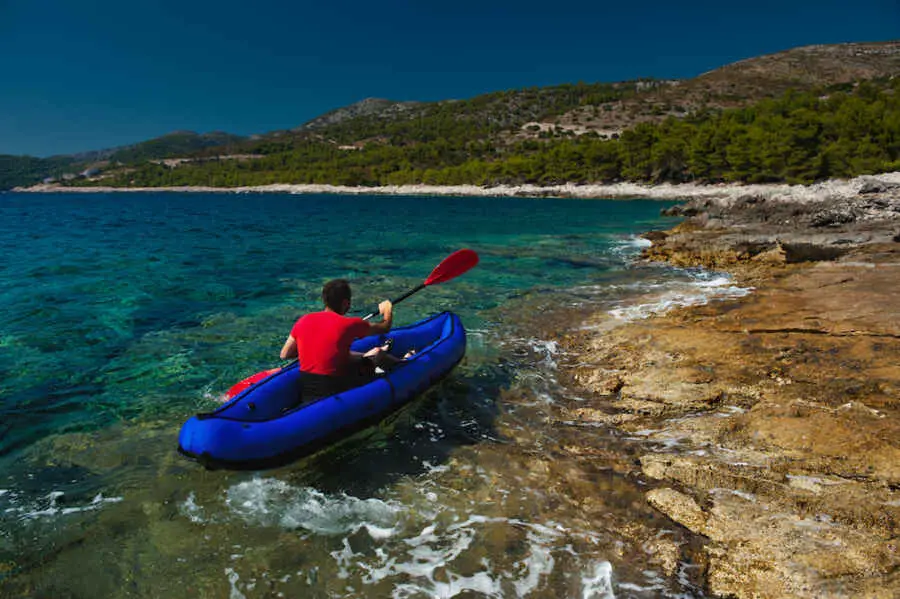
    Inflatable kayaks are a brilliant alternative to traditional kayaks.

    They are easy to transport, compact, and are almost always cheaper than their fiberglass or plastic counterparts.

    There is no shortage of inflatable kayaks on the market, and picking one among so many options can be a daunting task.

    From these options, those that stand out, especially for being budget-friendly, are Intex kayaks.

    This Intex inflatable kayak review is a low-cost, two-person kayak perfect for a leisurely day on the water.

    Intex Inflatable Kayak Review

    Intex is a California-based brand that has been in business for more than 20 years.

    Throughout the years, it has grown to sell its products in more than 100 countries.

    Other than the inflatable raft, Intex manufactures several different kinds of inflatable products, too, such as pools, toys, air beds, and more.

    A great thing about this brand is that it provides good customer support for all its products.

    You can also purchase any replacement parts on their website.

    For this review, we’ll be taking a close look at Intex’s Explorer K2.

    Who Is the Intex Inflatable Kayak For?

    Those who have never used an inflatable kayak before often tend to shy away from it.

    Let us assure you that you will have a great time on the water with the Intex Explorer K2.

    Below, we will list the reasons why this kayak might be a good pick for you.

    • Those with Limited Storage Space

    Unlike traditional hard-shell kayaks, you can deflate the Explorer K2 easily and store it in a bag.

    You can then throw it in the back of your closet or the trunk of your car.

    It is important for folks who live in smaller spaces, as storing a hard-shell kayak is practically impossible for them.

    • Those Who Enjoy Frequent Trips

    Anyone who has used a traditional kayak knows how difficult it is to get it on top of the car during trips.

    Thankfully, this isn’t going to be a concern anymore with the Explorer K2.

    It is incredibly light and compact that you can carry it by hand if you’re flying somewhere.

    It is definitely a suitable product if you want to explore foreign waterways.

    • Those Looking for a More Practical Kayak Than Hard-Shells

    When you actually have to use it, you’ll find that it takes less time pulling it out and inflating it.

    This is especially true if you compare the process with taking out a hard-shell kayak in the water.

    • Those on a Budget

    The Intex Explorer K2, and most other inflatable kayaks, are much cheaper than a hard-shell kayak.

    As such, they are perfect for anyone on a tight budget and beginners who aren’t sure yet if they’d like this activity.

    What’s Included?

    When you purchase the Intex Explorer K2, it will come to you neatly in a small cardboard box.

    The box contains a zippered carry bag where you’ll find the kayak and some extras:

    • Air pump
    • Paddles
    • Two single-piece seats with Velcro fitting
    • The fin you’ll place at the bottom of the kayak
    • A user manual
    • The deflated kayak itself

    We like how easy it is to unpack everything and how quickly we can set the whole thing up.

    In fact, you’d be able to inflate the kayak in under 10 minutes.

    Additionally, Intex offers a 90-day warranty on the Explorer K2.

    Overview of the Features

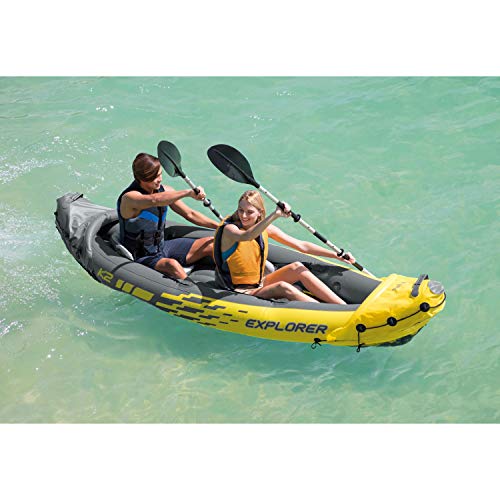
    The Intex Explorer K2 is an inflatable tandem kayak that looks a lot like a banana.

    This kayak is the real deal. It comes at a great price point and is as efficient as a high-end inflatable kayak.

    Made from rugged vinyl, you will find that it is highly durable and sturdy.

    Unlike hard-shell kayaks, it is compact, lightweight, and takes just a few minutes to assemble fully.

    There are plenty of features in this small package, so let’s shed some light on all of them.

    • Long-Lasting Build

    The Intex Explorer K2 features a vinyl exterior that makes it highly durable.

    You will find that it is capable of paddling over debris and getting pushed off of rocks.

    Basically, the kayak is an impressive heavy-duty and super-tough 30-gauge vinyl over a 1,200-denier nylon shell.

    The problem is, the overall construction of the paddle seems to be too flimsy.

    While it will work fine in extremely calm waters, we wouldn’t recommend using it anywhere other than that, especially in rougher waters.

    You can always consider purchasing a separate pair of paddles since this kayak is so inexpensive.

    • Safe and Practical Design

    It is a known fact that inflatable kayaks have a bad rap for being unreliable and flimsy.

    However, this won’t be something you will complain about with the Intex Explorer K2.

    This is a well-designed kayak, and its structure involves two completely separate air compartments.

    While this does not mean that the kayak is not sink-proof, you are definitely safer.

    Even if the kayak does end up getting ripped or gets a hole in the vinyl, it will not burst suddenly.

    This feature is essential, as it will give you time to head towards the shore before you are completely soaked.

    An I-beam also runs down the center, which does a great job of keeping the kayak rigid and stable, even if two people are sitting in it.

    • Ease of Use

    Since the Intex Explorer K2 is easy to maneuver and paddle, it is ideal if you are looking to explore small lakes and calm rivers.

    The kayak’s removable skeg further gives you the option for increased directional stability.

    We must stress, though, that the kayak isn’t ideal in windy conditions or rough waters.

    In these conditions, it becomes challenging to keep it in a straight line.

    Even with the skeg support, winds can easily impact this inflatable kayak’s buoyant nature.

    That said, the kayak is still quite hard to tip over and remains impressively stable.

    If you do end up capsizing or decide to step out of the kayak to take a swim, you’ll find that it is effortless to get back on.

    It is an ideal option for light paddlers or beginners who aren’t looking to make any serious maneuvers.

    • Value for Money

    In addition to Intex Explorer K2’s light and compact build, you will appreciate just how budget-friendly it is.

    Considering how many features it has, the Explorer K2 remains significantly cheaper than hard-shell kayaks.

    It also comes with an air pump and two paddles, making it a great option for those on a tight budget.

    There is no doubt that a fiberglass kayak has significantly better quality than an inflatable kayak.

    Yet, if you don’t have thousands to spend on one, you’ll be better off with an inflatable kayak.

    Pros:

    • Comes with extras
    • Very inexpensive
    • Low and stable
    • Easy to set up
    • Ideal for beginners
    • Does not tip over easily

    Cons:

    • The paddles are of average quality
    • Not ideal for rough waters or bad weathers

    How to Make the Most Out of It

    It is clear that the Intex Explorer K2 has a lot to offer.

    The problem is, all of these features can be confusing to decipher for folks who have never used an inflatable kayak before.

    To help you out, here is a video you can use as a reference.

    It will help you master how to use the Explorer K2 by showing you everything you will get to enjoy if you do buy it.

    Alternatives

    The Intex Explorer K2 is everything you would want in an inflatable kayak, and it comes at an affordable price, too.

    Yet, like most other kayaks, there are some downsides to it, too.

    For that reason, we felt it would be best to provide you with some good alternatives.

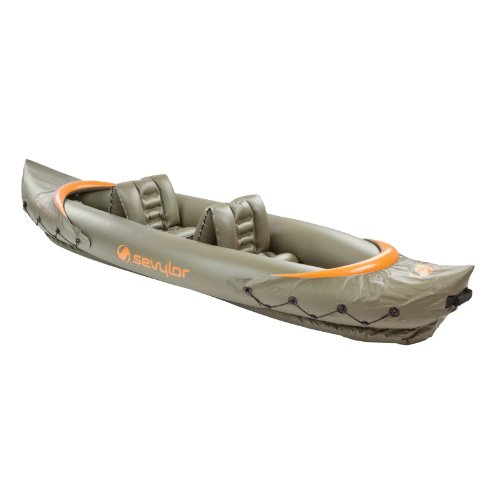
    1. Sevylor Tahiti Hunt and Fish Kayak

    The Sevylor Tahiti Hunt and Fish kayak comes in a similar price range as the one from Intex.

    However, instead of just for leisure, it is designed to cater to those who want to hunt or fish from their kayak.

    It can hold more weight in comparison and also features splash covers to keep you dry.

    This Sevylor kayak also comes with a carry bag so that you can easily travel with it.

    2. Advanced Elements Convertible Inflatable Kayak

    The Advanced Elements Convertible Inflatable Kayak is another excellent alternative to the Intex Explorer K2.

    Quality-wise, it is a significantly better option than most inflatable kayaks on the market.

    It has aluminum ribs that give it more structure and stability and also make it easier to maneuver.

    You will also find that it comes with multiple layers of material, making punctures less likely.

    Quickly, you will realize that it moves like a traditional hard-shell kayak and is easier to paddle straight as you ride it.

    The biggest drawback is that it is significantly more expensive.

    Is the Intex Inflatable Kayak Worth It?

    We hope our detailed Intex Inflatable Kayak review has provided you with all the information you were looking for.

    If you ask us, we think that the Explorer K2 is a decent lake-worthy kayak.

    It comes with everything at a great price point and provides you with the perfect amount of fun and access.

    Best of all, it is exceptionally lightweight.

    After deflating it, you can simply roll it up and throw it in the trunk of your car.

  • Best Inflatable Kayaks of 2021: Complete Reviews With Comparisons

    Best Inflatable Kayaks of 2021: Complete Reviews With Comparisons

    Looking for an enjoyable way to explore the waterways? Consider getting the best inflatable kayak.

    Besides being affordable, it is often more lightweight and more portable than a hard-shell kayak.

    As such, you can easily pack it and bring it with you on your travels.

    In doing so, your inflatable kayak actually saves you money, as you don’t need to rent one at every destination.

    If you’ve decided to get one, below are reviews of our top five picks.

    Best Inflatable Kayak Reviews

    1. Intex Explorer K2 Inflatable Kayak
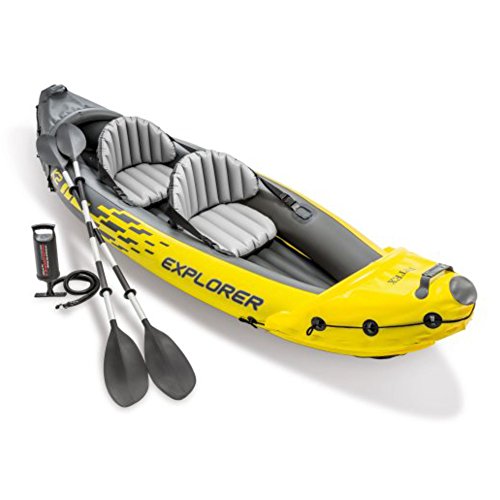
    The Intex Explorer K2 is a fun and sporty kayak with a streamlined design offering easier paddling.

    It has a brightly colored exterior with sporty graphics that makes it highly visible in the water.

    Since it comes with two seats, this is an excellent choice for people looking to experience mild rivers and lakes with loved ones.

    Best of all, you will find that it is compact, lightweight, and easy to assemble.

    Product Highlights

    The Intex Explorer K2 is a tandem kayak that closely resembles a banana, both in shape and color.

    Made from rugged vinyl, this budget-friendly kayak has proven to be sturdy and long-lasting.

    Unlike hard-shell options, it is compact, lightweight, and takes only a few minutes to assemble fully.

    In terms of its specs, the kayak comes with three air chambers and standard directional skegs.

    It has a maximum weight capacity of 400 pounds, and it measures 123 by 36 by 20 inches.

    There is an I-beam on the floor, providing the kayak with rigidity.

    The detachable skeg gives it its stability, which is necessary for paddling in windy weather conditions.

    As mentioned, it comes with two in-built inflatable seats.

    You can adjust and align these seats to your body to get ultimate comfort.

    To keep you safe and balanced, you will appreciate the addition of the handles located at each end of the kayak.

    Since this is a complete kayaking set, you also get an air pump, two paddles, and a carry bag with your kayak.

    Essentially, this means you won’t need to make any separate purchases if you pick the Intex Explorer K2.

    Instead, you can go straight into the water and start paddling.

    What We Like

    We like how brightly colored this kayak is, as it can be helpful in emergencies.

    The adjustable seats add more comfort when sitting in the kayak, making it easier to paddle.

    Lastly, a repair kit comes in handy when you have to deal with unexpected damages.

    What We Don’t Like

    We found the kayak not being suitable for larger-bodied individuals. The paddles are also of average quality.

    Pros:

    • Budget-friendly
    • Easy to assemble
    • Sturdy and durable
    • Lightweight at 30 pounds
    • Impressive weight capacity

    Con:

    • Average quality paddles

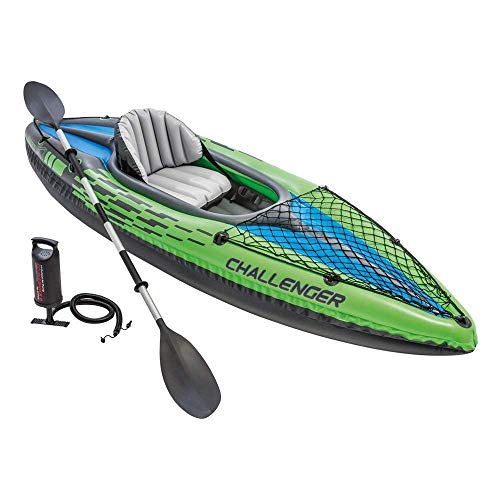
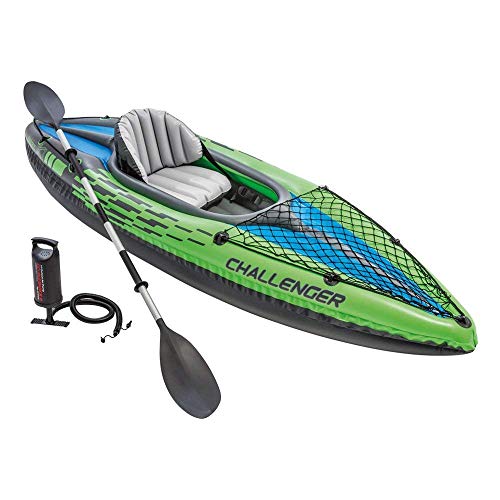
    2. Intex Challenger Kayak

    When it comes to inflatable kayaks for those on a tight budget, Intex is the go-to brand.

    We had to include another Intex product, as they know exactly what makes up a good inflatable kayak.

    The Challenger is a single-person kayak that is easy to assemble and use.

    It is one of the least expensive options you’ll find on the current market.

    While it may not be fully advanced, it will keep you afloat and get you around in the water.

    Product Highlights

    The Intex Challenger is a durable and agile kayak made of a strong welded material.

    It is brightly colored with eye-catching graphics all over that make it visible even if you are at a distance.

    Its vibrant color is also an added safety feature in case you are in an emergency.

    This kayak is ideal for slow-moving rivers or lakes, and its cockpit is designed for maximum space and comfort.

    It also features an I-beam on the floor, which adds more stability.

    Additionally, you will find an adjustable inflatable seat with a backrest that keeps you comfortable while paddling.

    For those looking to store things, you can take advantage of the cargo net in the front.

    There is also a grab line on both ends of the kayak.

    The kayak comes with an 84-inch aluminum oar, along with a repair patch and hi-output manual hand pump.

    Measuring 108 by 30 by 15 inches and weighing only 27.2 pounds, the Challenger is more lightweight than the Explorer K2.

    However, it has a lower maximum weight capacity at just 220 pounds.

    What We Like

    Like the previous Intex kayak, the Challenger is also built well and made from a durable material that will last a long time.

    We like that there is a cargo net that allows you to store your belongings.

    The I-beam is an excellent feature, too, providing the vessel with good stability.

    Lastly, the adjustable seat adds to the overall comfort you feel as you paddle.

    What We Don’t Like

    The Challenger might not be the kayak you should be considering if you are a tall and well-built person.

    Anyone over six feet will have a hard time using this kayak.

    Pros:

    • Well-built
    • Comfortable seat
    • Lighter than the Explorer K2
    • Storage option

    Con:

    • Not ideal for taller people
    • Can only carry 220 pounds max

    3. Bestway Hydro-Force Cove Champion Inflatable Kayak
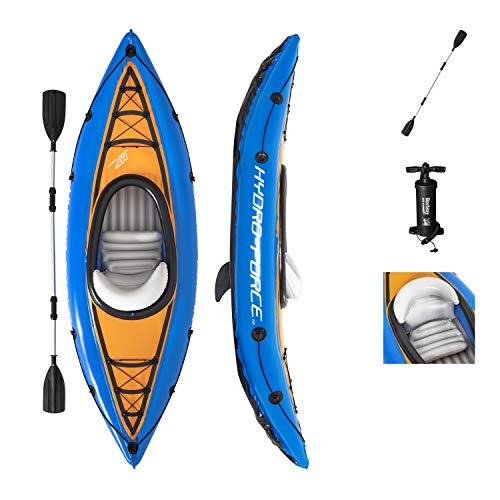
    Ocean or river, the Bestway Hydro-Force Cove Champion is a kayak that will work exceptionally well.

    It is a full set complete with a pump, paddle, and patch.

    More than anything, you will appreciate that it is easy and quick to set up.

    You will also find the cockpit comfortably-sized and features an adjustable seat and a backrest for additional support.

    This an easy-to-use and -store kayak that will bring out your inner explorer.

    Product Highlights

    The Hydro-Force Cove Champion is a single-person kayak that can comfortably accommodate a maximum weight of 220 pounds.

    It comes complete with a durable, double-sided paddle, a heavy-duty repair patch, and an air hammer hand pump so you can quickly take it out into the water.

    There is a wide-opening cockpit on this kayak that features an adjustable seat.

    This seat boasts a backrest to offer extra lumbar support when kayaking for hours.

    There are also removable fins, adding directional stability.

    You will find a ton of storage areas for your adventure and travel equipment or necessities.

    The kayak is extremely lightweight, and upon deflating, you can fold it down to a tiny size so that you can store or pack it easily.

    Lastly, a wraparound grab rope surrounds the whole exterior of the kayak for more manageable transportation.

    This design choice gives you the ability to tie the kayak up to an anchored spot or a dock.

    What We Like

    The Hydro-Force Cove Champion is a well-built kayak that takes only a few minutes to be fully ready.

    You will like that it has an adjustable seat with a backrest, offering you phenomenal support and comfort.

    There is ample storage space for your things, too.

    What We Don’t Like

    The sides of the kayak have two separate air chambers.

    This means if you haven’t filled the air properly, it can completely throw the kayak off balance.

    Pros:

    • Highly comfortable seat
    • Ample storage space
    • Easy to set up and use
    • Weighs less than 20 pounds

    Cons:

    • Can get off-balanced if not filled with air properly
    • Only 165-pound max capacity

    4. Advanced Elements AdvancedFrame Convertible Kayak
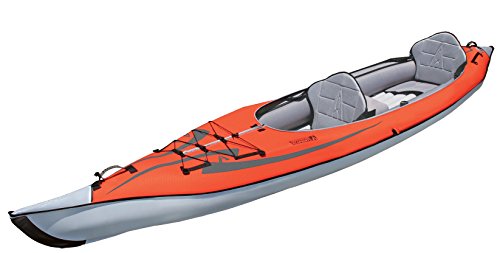
    The Advanced Elements Convertible Kayak is a 15-foot kayak featuring an open-deck design.

    It can go from an open to a closed deck in a matter of seconds.

    It combines a rigid bow and stern rib frame and the versatility of solo or tandem seating positions with interchangeable decks.

    Product Highlights

    This Advanced Elements kayak is an easy-to-use and straightforward vessel that arrives pre-assembled.

    All you need to do is unfold, inflate, and attach the seats, and you’re good to go.

    When folded, its size goes down to 35 by 21 by 12 inches, making it easy to carry.

    The maximum weight capacity is an impressive 550 pounds, though the weight of the kayak itself is 52 pounds.

    The kayak boasts three layers of materials that ensure exceptional puncture resistance.

    There are two detachable inflatable seats with three seat locations on the kayak.

    As such, you can either use it as a solo kayak or a tandem kayak.

    These seats are highly padded, adjustable, and have phenomenal support, providing the kayaker with ample comfort for hours of paddling.

    What We Like

    We like how well this kayak is built and that the whole setup process is quick and simple.

    The three-layered materials do a great job of protecting the kayak from damage.

    The fact that it has a massive 550-pound maximum load capacity is also an impressive feature.

    What We Don’t Like

    At 52 pounds, this isn’t the lightest kayak on the market. Compared to its counterparts, this is a bit pricier, too.

    Pros:

    • Doesn’t puncture easily
    • Can handle a lot of weight
    • Easy to set up and maneuver
    • Use as a solo or tandem kayak

    Cons:

    • Expensive
    • Slightly heavy

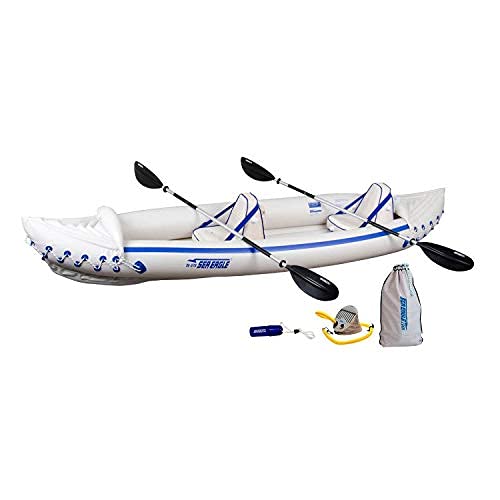
    5. Sea Eagle 370 Deluxe Inflatable Kayak
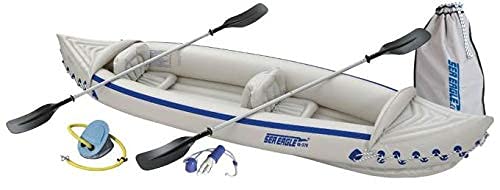
    Sea Eagle kayaks are quite similar to Intex kayaks in that they have a sun-resistant and durable construction.

    Even so, it is still a very light kayak, weighing just under 26 pounds.

    Product Highlights

    Made from durable molded plastic, the Sea Eagle 370 Deluxe can carry a maximum weight of 650 pounds.

    At 7 feet and 10 inches long, not only can it carry massive weights but also hold your onboard essentials.

    It features two molded skegs that protect the kayak from getting damaged by rocks that appear out of nowhere.

    The integral five-tube I-beam floor keeps it stable.

    What’s more, this design choice helps you speed up when you wish to and stop when you want to take a break.

    From its molded plastic construction to its impressive design, you can trust that this kayak can stand the test of time.

    What We Like

    One of the best things about this kayak is that it can hold up to three people.

    For its size, you will find that it is still easy to haul because it is so lightweight.

    Even though it’s so big, it can be inflated or deflated in under 10 minutes.

    What We Don’t Like

    The downside of this kayak is that it is not the most stable in windy conditions.

    Pros:

    • Can carry up to three people
    • Lightweight
    • Easy to set up
    • Comes with two movable seats
    • Includes paddles, carry bag, and a pump

    Con:

    • Not very stable in windy conditions

    Buyer’s Guide

    Any one of these best inflatable kayaks is sure to bring you and your family lots of fun.

    Still, if you have never used one before, we understand how deciding on just one can be challenging.

    To make your purchase easier, here are the most critical factors you would want to keep in mind:

    1. Type of Water You’ll Use It in

    The type of kayak you pick depends on the kind of kayaking you want to try doing.

    There are different types of inflatable kayaks, and some can withstand even the roughest of waters.

    Beginner or professional, if you enjoy whitewater kayaking, you will need to find an inflatable kayak for white waters.

    If you prefer kayaking on ponds or lakes, get a kayak that can track straighter and can deal with wind and waves.

    2. Seating Capacity

    Next, choose whether to get a single-person kayak or a tandem kayak.

    Trying to maneuver a tandem kayak by yourself can be quite tricky. Hence, if you’re going to go out by yourself, we recommend choosing a single-person kayak.

    That said, if you have children or wish to go with your partners, you will get a ton of value by selecting a tandem kayak.

    3. Weight

    It would help if you also consider the weight of the kayak before you choose one.

    A heavier kayak could be challenging to maneuver when you are in the water and even more difficult to transport between bodies of water.

    On the other hand, a heavier kayak may be beneficial to handle strong winds than lighter inflatable kayaks.

    If you are looking for one you can transport easily, a lighter one will definitely be the better choice.

    4. Length

    Longer kayaks have the advantage of tracking straighter in the waves and winds, but they have a hard time turning.

    Preferably, choose this type of length if you like kayaking in lakes and ponds.

    Shorter kayaks are great if you are looking for the most maneuverability.

    5. Sit-on-Top or Sit-In

    Inflatable kayaks most often come in one of two kinds with regards to their sitting position.

    Sit-on-top kayaks position the kayaker above the water and will typically feature comfortable chairs.

    These kayaks are mostly less streamlined, tend to be more comfortable, and are ideal for activities such as fishing and hunting.

    Sit-in kayaks, on the other hand, place the kayaker inside and enclosed in the kayak.

    These kayaks go much faster, are more streamlined but not as comfortable.

    6. Paddle Rest/Paddle Holder

    While most inflatable kayaks come with a paddle rest or paddle holder, some don’t.

    Obviously, it would be better to choose one that has a paddle rest.

    You do not want to be holding your paddles throughout the time you are kayaking, right?

    7. Storage Compartments

    Depending on how you intend to use your kayak, storage space can be an important feature.

    Kayaks with storage compartments will often come with a waterproof section and areas that can strap on packs and more.

    Make sure you check out the features of the compartment before you settle on a kayak.

    8.Extra Features

    Kayaks can come with several additional features, such as seating features, fishing attachments, and a plethora of other extras.

    If you know exactly what you will be using your kayak for, look for those features as they can be quite important.

    Inflatable Kayak FAQs

    1. Are inflatable kayaks any good?

    Depending on your usage and preferences, you’ll find that inflatable kayaks can be good investments.

    After all, these tend to be hard-wearing, stable, and robust.

    At the same time, they are portable and lightweight, making them much easier to manage than their hard-shell counterparts.

    2. How long does an inflatable kayak last?

    An inflatable kayak can easily last anywhere between five and 10 years.

    However, that still depends on how you are using it and how well you take care of it.

    3. Are inflatable kayaks hard to paddle?

    Since these tend to be so lightweight, inflatable kayaks are pretty easy to paddle.

    Still, this only applies to calmer waters.

    If you are using an inflatable kayak in rougher conditions, it will be more difficult to paddle.

    4. Do alligators attack inflatable kayaks?

    Yes, alligators can attack inflatable kayaks.

    While we can’t exactly say how often, in most cases, the odds of it attacking your kayak are relatively low.

    If you are kayaking in places where alligators are native, there is a higher chance of that happening.

    5. Do I need a license for an inflatable kayak?

    For most states, no, you do not need a license for an inflatable kayak if you will use it only in the sea.

    However, some states may require you to register your inflatable kayak.

    It’s best to check with officials before you use your kayak.

    What Is the Best Inflatable Kayak to Buy?

    Our personal favorite is the Intex Explorer K2 Kayak, which has the perfect combination of great features and price.

    It is well built using durable materials, easy to set up and compact, and is suitable for lakes and calm rivers.
  • Canoe vs Kayak: What’s the Difference?

    Canoe vs kayak, which one is best suited for you?

    To know that, you first need to understand each one of them and also know the differences between canoeing vs kayaking.

    Right off the bat, you will find a ton of similarities between the two.

    For example, they’re both waterborne vessels that have been used for thousands of years.

    They also both come with paddles and prevent you from taking an untimely and unwelcome bath in water.

    With so many similarities, are there any differences between the two?

    Even though several people tend to use these two words interchangeably, there is a clear distinction between a canoe and a kayak.

    They both have different gears; the vessels themselves have a number of differences, even their history is quite different, and that’s what we aim to shed light on today.

    Canoe vs Kayak

    Before we can even talk about the differences between the canoe and kayak, we must talk about what they each are.

    What Is a Kayak?

    Kayaks are a type of boat. They often tend to be small and slim and are either used by a limited number of people or by a single person.

    There are many different kayaks on the market, and each of their designs differs based on their usage.

    If classified broadly, the major types of kayaks include fishing, leisure, surf play, and tour kayaks.

    What Is a Canoe?

    Canoes are shaped similarly to the kayak, but the major difference is that they aren’t enclosed.

    The canoe is completely open and can carry multiple people at a time. It is known for being quite sturdy as it can withstand white waters.

    Canoes are often used for attracting tourists and for sightseeing purposes.

    Brief History of Canoes and Kayaks

    Below are some important facts as to how canoes and kayaks came about.

    Canoes

    The word canoe comes from the Carib kenu (dugout), from the Spanish canoa.

    If you think about it, the name makes a lot of sense, and indeed, a dugout canoe is still an alternative name for a canoe, especially one that is made out of a hollowed tree trunk.

    One of the earliest canoes discovered is the Pesse canoe. It can be dated back to 8200 BC and was found in the Netherlands.

    It is the oldest canoe ever found and the oldest known boat in the world.

    The indigenous people of America were also known for their canoes.

    When the Europeans started exploring the Americas in the 14th, 15th, and 16th centuries, they were quite impressed with the designs of these canoes.

    This is what led the canoe to play such an important role in European exploration, particularly in the interior of North America.

    Kayaks

    Kayaks can be traced back to the Inuit tribes in Canada, Greenland, and Alaska.

    These were typically used for hunting and made out of wood with seal skin stretched over for an enclosed top.

    It was the Scandinavian explorers who took up kayaking later and made it so popular in Europe.

    Canoeing and Kayaking

    In the early 20th century, canoeing was featured as a demonstration sport at the 1924 Olympic Games.

    Over a decade later, at the infamous Olympic Games of 1936, since Adolf Hitler’s Nazi Germany hosted it, canoeing became a full Olympic sport.

    There were about nine games, all in the canoe sprint that were held that year. Only men were allowed to participate in all of these games.

    It was only 12 years after that kayaking and canoeing both entered the Olympics as a women’s sport.

    We have come a long way since then. Even the materials used to make canoes and kayaks differ.

    These days you will find materials such as rotomolded polyethylene used commonly to make them.

    The biggest benefit of this material is that it is quite cheap, highly flexible, and resistant.

    Fiberglass is another common material used to make canoes and kayaks.

    These tend to be quite lightweight, durable, easy to repair, and highly responsive.

    You can still find canoes and kayaks made out of wood, but they’re not recommended for use in white waters.

    Wooden canoes and kayaks are a great way to make you feel like an old-timey explorer.

    difference between canoe vs kayak

    What Is the Difference Between a Canoe and a Kayak?

    When looking to participate in a new water sport, many beginners tend to have difficulty choosing between canoeing vs kayaking as they both seem quite similar.

    For you to know the exact differences between kayak vs canoe, we need to talk about five fundamental points.

    Paddles

    The paddlers in a canoe are typically single-bladed, flat blade paddle that allows easy navigation through the waters.

    A kayak, on the other hand, features paddlers that use a double-bladed curved paddle instead.

    This feature is extremely important as the differences in these paddles could cause these vessels to move differently.

    The players would also need to learn how to use them.

    Paddlers’ Sitting Position

    The sitting position in both of these boats differs quite a bit.

    In a canoe, the paddler will typically kneel or half-kneel inside the vessel.

    On the contrary, in a kayak, the paddler will sit on a low seat with his or her legs stretched fully in front of them inside the vessel.

    Boat Structure

    Canoes typically have pointed ends on both sides and have an open deck which means that the inside of the boat is completely open and uncovered.

    Kayaks typically have a closed deck which means that the inside of the boat is completely covered and surrounds the paddler.

    Vessels’ Weight

    Typically, kayaks tend to be narrower in structure and lighter in weight compared to its counterpart.

    This is why when you paddle the kayak on the water, it tends to float.

    Canoes are mostly wider in structure and heavier, so more of their surface area touches the water.

    Speed

    Between kayak vs canoe, the former is designed to be faster and more agile than the latter.

    That is mainly because of its smaller size and lightweight.

    That said, a professional paddler can paddle a canoe as fast as kayaks.

    As a beginner, though, stick to kayaks if you are looking for faster speeds, but choose canoes if you are looking for more roominess.

    Is It Easier To Kayak or Canoe?

    When we talk about which one of these two is easier, we mostly refer to the canoe vs kayak stability.

    The design of each of these boats is where you will find the answer to which one of the two is more stable.

    Since the canoe features a wider beam, they tend to be more stable.

    In fact, when you are using this in flat water, you can be certain about the stability of this boat. Even getting in and getting out is easier.

    That said, all of this changes if you use this boat in whitewater conditions.

    There is a higher risk of the canoe capsizing mainly due to its beam design. Furthermore, it is tougher to fix an overturned canoe unless you have been trained to do so.

    As for its counterpart, it features a fairly narrow beam that makes it trickier to get in and get out of, which often gives an impression of it being quite wobbly.

    That said, once you are in rough and fast water, you won’t have a tough time with a kayak.

    You will find it easy to do an “Eskimo Roll” even if the kayak tips over, and you will be back on track quicker than ever.

    In short, when it comes to canoe vs kayak stability, it entirely depends on the water conditions.

    Do Kayaks Flip Over Easily?

    With their lightweight and narrow structure, there is often a worry about the kayak flipping over.

    But how often does this happen?

    Kayaks are typically quite safe to use and don’t tip over as easily, but the risk of the vessel tipping over depends on a couple of factors.

    Those include the type of kayak you are in and the type of water where you are paddling.

    For example, it is extremely hard to tip over when you are paddling a recreational kayak on relatively calm waters, of course, unless you are really trying hard to tip over.

    However, if you are paddling with an ultra-light or sea kayak in white waters, it comes with a high risk of the kayak flipping over.

    While you cannot prevent every flip, there are a couple of techniques that can reduce the chances of the kayak capsizing enormously.

    The common ways you can prevent the kayak from flipping over is by choosing the right water conditions and balancing your kayak.

    It will take time to get the hang of these techniques as a beginner, but once you get good at them, you will no longer be as worried about the kayak flipping over as these techniques will become almost instinctive.

    Which Is Better a Kayak or Canoe?

    As you may have gathered so far, there are both upsides and downsides to canoe vs kayak.

    Whichever one you choose between them will largely depend on your preference and situation.

    As a beginner, we recommend trying out both before deciding to commit all your money and time to one.

  • The Top 5 Bass Fishing Guides for Lake Kissimmee

    The Top 5 Bass Fishing Guides for Lake Kissimmee

    The Best

    Florida Bass Charter–407-821-6101 Captain Tim and his fantastic team specializes in live bait and artificial bait trips. They know every technique that will catch you largemouth bass in Florida. This is not just a job for Captain Tim; this is his life and his passion. He is the best bass Fishing Guide for Lake Kissimmee. He lives to fish, and he enjoys taking vacationers out and sharing his expertise. The crew at Florida Bass Charter are United States Coast Guard certified. They follow all safety measures, and they are ready and willing to teach you all the techniques you need to know to catch largemouth bass in Florida. Give him a call and book your trip now. 

    Florida Bass Charter Gettin-er Done

    If you are looking to catch trophy bass, you need to visit Kissimmee, Florida. Kissimmee Lake is the third-largest in Florida, offering 35,000+ acres of fantastic angling and stunning scenery. Lake Kissimmee is the largest with the Kissimmee chain of lakes, located 15 miles away from Lake Wales and approximately 40 miles from Orlando, Florida. Forget the amusement parks, museums, and other attractions and book a fishing guide for a day. Go out and have an adventure. Explore the beautiful Florida waters, learn how to fish for the first time, or try to catch a huge trophy bass. 

    Lake Kissimmee has slightly warmer water temperatures than some other lakes in this area. Because of this, you can see many largemouth basses. There are many anglers in this area that will fish Kissimmee during summer. With a combination of heat and warmer water temperature, you will find an abundance of largemouth bass. If you can schedule your vacation/fishing trip during the complete moon phase, you can catch bass closer to the shore.  

    Fishing on Lake Kissimmee

    If you are an experienced angler, a pro, or use a guide, make sure you take advantage of the thick vegetation. All the guides will know this and know where the hot spots are going to be. Kissimmee doesn’t become as crowded as some of the more transparent lakes in Florida because of the heavier vegetation. An ideal hiding place for the Bass in this area; eelgrass, bulrush, and knotgrass. These vegetation types help protect bass, allowing them to grow to Lake Kissimmee’s large sizes. 

    One of many highlights for fishing on Lake Kissimmee is catching Bass between 5-8 pounds. Now and then, some anglers can wrangle in a 10+ pound largemouth bass. While out on Lake Kissimmee, keep your eye out for large sections of reed or eelgrass. This is where you can find larger schools hiding out. 

    Tips for Fishing on Lake Kissimmee

    Fishing on the upper area of the chain of Kissimmee lakes can be a little more challenging. This area is more acidic and has tannin-stained waters. The lower Kissimmee chain has more shallow water and is sensitive to changing weather fronts during colder months. A lot of anglers choose to wade fish. Many boat ramps and fishing camps will grant access to wade fishing. In the Florida lakes, watch out for hydrilla. Hydrilla can make navigating these waters complex, so it is recommended to use a fishing guide if you have never been on Florida’s water.

    When fishing on Lake Kissimmee during spring and winter, for best results, use flipping plastic baits or a slow-trolling golden shiner. If you search for largemouth bass during the fall or summer months, your go-to lures will be plastic worms, rattling crankbaits, and jerk baits. You will want to have a good arsenal of lures and other equipment no matter what time of year you go out fishing for largemouth bass. 

    Popular lures for Lake Kissimmee 

    The type of lure you use will depend on the area you are planning to fish and the kind of fish you plan to catch. I am providing a shortlist below some of the most popular lures for catching Largemouth Bass in Florida, specifically Lake Kissimmee and the surrounding area. 

    JerkBait

    This type of bait is perfect when fishing around hydrilla or eelgrass that are abundant in Florida lakes. Using your rod tip, you need to perform a complex jerking motion to get through the thick vegetation. Using jerk baits, you want to mimic shad and shiner colors, as this is the type of prey that bass is attracted to. 

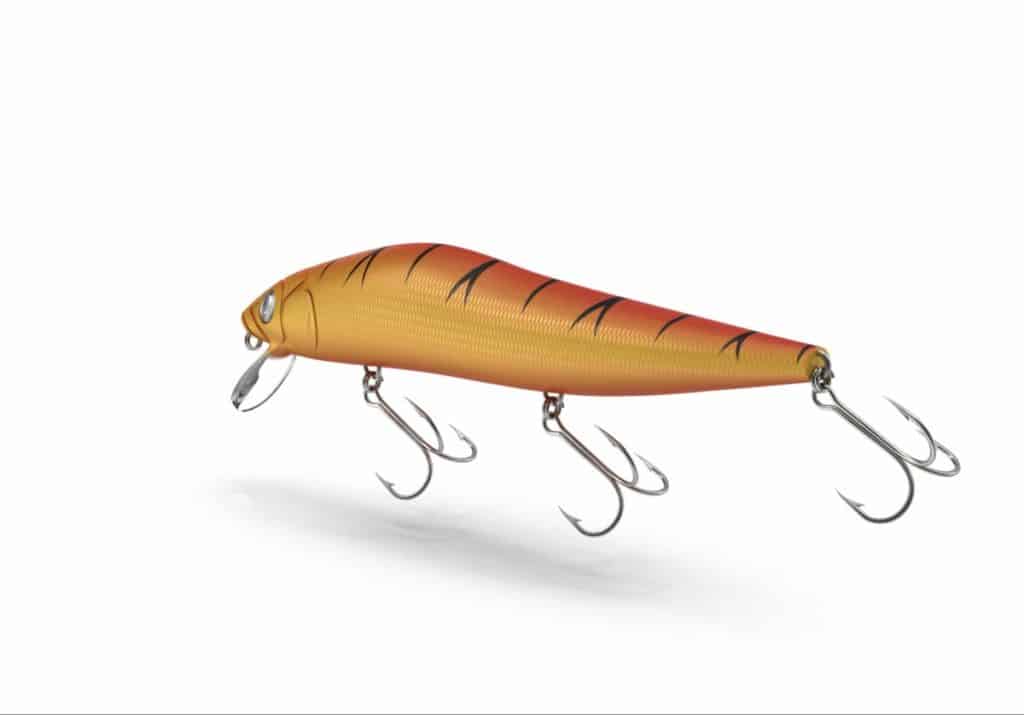
    jerk bait

    Speed Worm

    Speed worms are the most popular and most versatile lure that you can use to catch Bass in Florida. You can use the speed worm; use it along with a heavyweight in cover, choose to worm it on the bottom of the lake, swim it back to you, or use it as a top-water lure. 

    Swim Bait

    This type of bit works exceptionally well around grass and lily pads on Lake Kissimmee. It is effortless to use; rig it up on a lightly weighted swimbait hook, throw it out, & reel it in slow and steady. The fish will go crazy! Make sure you are in or around some vegetation. 

    Spinnerbait

    With spinnerbait, you can catch trophy-sized bass. All you need to do is find an abundance of baitfish swimming around and toss in a white spinnerbait. Spinnerbait may not catch you the most fish, but it could snag you the biggest Bass of The trip if used correctly on Lake Kissimmee.

    Rattletrap

    This style of bait is best in the same areas and situations as your jerk bait. The thickness of vegetation will determine how you use a rattletrap; if hydrilla is thick, then you want to throw your rattletrap out and steadily reel it back in. If you are in sparse vegetation, you can do the Yo-Yo technique; bounce your line up and down. 

    Lakes in The Kissimmee Chain

    The lakes within the Kissimmee chain of lakes range in size from about 200 acres to 44,000 acres. The smaller lakes will, of course, have more limited fishing opportunities. I have included three of the most popular Bass Fishing lakes in the Kissimmee chain below. 

    Lake Tohopekaliga

    Twenty-two thousand seven hundred acres make up the most famous lake in Florida and the entire country. It is well known for producing more trophy Bass consistently than any other lake. According to Florida Wildlife Commissions’ biologist, for every 10-acres of land, there is one Bass over 10-pounds. Bassmaster Magazine has named Lake Toho “the most consistent lake for both numbers and trophy-sized bass.”

    Lake Hatchineha

    A top-class bass area, Lake Hatchineha offers gorgeous scenery. This lake is smaller and less known than other lakes in the Kissimmee chain. At only approximately seven thousand acres, Lake Hatchineha is a favorite spot for local anglers. The average depth is only 3-feet, and the deepest area comes in at 8-feet, making it one of the shallowest. Fishing on Lake Hatchineha is best done during the early mornings, evenings, late at night during summer, or in winter months.

    Cypress Lake

    At Cypress, you cannot only catch your share of largemouth bass, but you also see a variety of wildlife. Alligators, Osprey, and Eagles, among many others. All are living in their natural habitat. Cypress Lake has a record of 18-pound largemouth bass. This part of lake Kissimmee is best fished during the fall months but produces largemouth bass all year round. The locals prefer to slow-troll small jigs, which helps them locate the schools of baitfish. 

    Top 5 Fishing Guides

    I’ve given you information about the fishing on Lake Kissimmee and the surrounding areas. Now, I will provide you the names of the top 5 best fishing guides in this area. They will all make sure that you have all the information that I didn’t include. Your guides will also make sure that you have an incredible time on your Florida fishing adventure. 

    1. Florida Bass Charter–407-821-6101                                                        

    Captain Tim and his crew use top-of-the-line equipment and fishing gear at all times. He also guarantees that you will get your money back if you do not catch a fish with a wild shiner. No matter how many people want to go out fishing with Captain Tim, he can accommodate. If you need one boat, he has it; 5 boats are doable, and even 15 boats work just fine. Captain Tim not only owns Bass Fishing Charter, but he also has a bait and tackle shop that other fishing guides in the area use; Get Hooked Magic Baits. During the off-season, Captain Tim fishes the Florida lakes at the pro level.                                     

    2. Super Bass Fishing Guide Service                             

    Captain Joe Ventrello will provide his clients with conclusive guidance and instruction to ensure they have a successful Florida fishing experience. Captain Joe welcomes people of all skill levels and all ages to use his guide service. He also has extensive knowledge of tackle and other products to help make your trip a fun success. You can choose to go out on the lake with Captain Joe for a full day or ½ day of angling fun. Super Bass Fishing Guide Service is family-friendly (they welcome and enjoy children) and has everything that you could need for your fishing experience; Bring yourself.    

    3. Central Florida Bass Fishing                                           

    They have recognized captain John Leech on ESPN, Field & Stream, Outdoor Channel, and more. Captain John is well known in this area and will take you out Bass Fishing on Florida’s best lakes. He will consider the weather, water level, and time of year and then decide where the best place to go fishing for the day. After you guys meet up, first thing in the morning, you will make a stop for needed bait, food, drinks, and whatever else you will need for your adventure. You have package options that include 2, 4, 6, or 8-hour options. Captain John will make sure that you have an exciting, memorable trip and that you finish your day toting many basses to shore.

    4. Orlando Fishing Guide                                          

    Captain Randy Dumars specializes in artificial and live bait; The Orlando Fishing Guide team is here to help you accomplish your dream; catching a trophy-sized bass. They use state-of-the-art bass fishing boats or bay boats, and each guide is professional and exceptionally knowledgeable on Kissimmee and the surrounding lakes. Call them or visit their website today and book your Bass Fishing trip. They are ready and excited about taking you out on the waters of Florida, providing you with an exceptional experience of a lifetime. 

    5. Horizon Fishing Charters                                          

    Captain Brent Kirkendall is located in Lake Toho Fishing Camp. Horizon offers ½ day, ¾ day, and full-day options. They are only available for Lake Toho and Lake Tarpon, but they know all the secret “hot spots” in those areas that will produce large Bass numbers. All of your gear is tournament grade, from the boat to rods, reels, fishing lines, and more. They will instruct you on different techniques using a variety of lures. They use bass boats that can navigate shallow areas where larger vessels can not go. 

     Conclusion

    If you are looking to snag that trophy bass or go bass fishing, Kissimmee Lake and surrounding areas are the most productive areas. There are a large variety of places along Lake Kissimmee that the bass fishing guides can take you. They know all of the best places to fish at each particular time of the year. They can look at the weather and the fishing report and know exactly where to go for the day. All the fishing charters in the Kissimmee area are very knowledgeable and have been taking visitors out fishing for many years. You can be confident that whichever fishing guide you choose from the list above, you are going to have the time of your life. I will guarantee you that you will catch an abundance of largemouth bass when you fish on Kissimmee Lake. Remember to purchase your Florida fishing license and call in advance to book your Florida Guide/Charter, they get booked up in a hurry just before the summer season.                                                                                                        

  • Best Kayak for Beginners of 2021: Complete Reviews With Comparisons

    Best Kayak for Beginners of 2021: Complete Reviews With Comparisons

    Considering there are so many options of kayaks on the market, it can be frustrating to know which one is ideal for you.

    That is especially if you are a beginner.

    The best kayak for beginners isn’t the kind you would want to have a wild time in the waters.

    These are meant to offer a safer and more stable time on lakes, slow-moving rivers, and calm seas.

    Our team of experts tried and tested some kayaks and have settled on five that are perfect for any beginner.

    Best Kayak for Beginners: A Review

    1. Intex Challenger K1 Inflatable Kayak

    The Intex Challenger K1 isn’t necessarily the one that comes to mind when you think of kayaks.

    It is incredibly affordable, so you wouldn’t assume that it would be great to paddle.

    However, upon trying out this inflatable kayak, we were left truly amazed at how durable it is and how much fun it was using it.

    Review

    There is a lot to unpack with the Intex Challenger K1 Kayak, and we will talk about it in detail below.

    • Portable

    This kayak may be one of the most portable kayaks on the market. It can fold up into less than a quarter of the size of the fully inflated kayak.

    You can conveniently store the deflated kayak in a small bag provided by the brand itself. It is easy to carry too.

    In addition to the kayak, the bag can also carry all the other equipment, including the paddle and pump.

    When fully packed, the dimensions of the bag are 23” x 14” x 8”.

    • Construction

    The Intex Challenger K1 is made with a welded vinyl construction.

    While this is quite durable, we would recommend being careful around sharp objects and not dragging them over rocks and gravels.

    The one-way valves are quite durable. They work perfectly fine and are easy to figure out too.

    We also did not find any issues with inflating the Intex Challenger K1 or leakage.

    • Performance

    Considering how reasonably priced this kayak is, you wouldn’t think that it would perform extremely well, but we have to say we were quite impressed.

    We had no trouble keeping the Challenger paddle in a straight line.

    Of course, you aren’t going to be breaking any speed records with it, but that’s not even important as a beginner.

    You will truly appreciate how easy it is to paddle, the little effort needed to propel it forward, and how effortlessly and quickly it turns.

    • Comfort

    The Intex kayak is quite comfortable to use and has ample legroom too. It can easily accommodate a person over six feet tall.

    The inflatable seat is surprisingly quite comfortable, and even the back support was fairly decent.

    The seat secures to a Velcro strip on the kayak’s floor, which also attaches to the floor’s D-ring.

    The kayak has a width of 30”, which doesn’t require a lot of reach when paddling.

    That means the Intex Challenger K1 would be ideal for kids too.

    • Setup

    Setting up the Intex Challenger the first time took us about 10 minutes, of which seven minutes were spent inflating it and the other three securing the seat, attaching the paddle, and sliding in the fin.

    However, you will spend less time the more you do it.

    The kayak comes with a small hand pump that is significantly smaller than the ones we’re used to, something we did not like.

    Also, there isn’t a pressure gauge on this pump, so you will not know what air pressure you’re inflating it at.

    Pros:

    • Affordable
    • Easy to store and travel with
    • Lightweight
    • Easy setup

    Cons:

    • Average hand pump
    • Not the most durable built

    2. Lifetime Tamarack Angler 100 Fishing Kayak

    The Lifetime Tamarack Angler 100 has all the features typically needed in any standard fishing kayak.

    The kayak is ideal for beginners and professionals since it provides comfort, stability, and safety.

    Review

    Below we will cover all the important features the Tamarack Angler 100 has to offer.

    • Comfort

    What sets the Tamarack Angler Kayak apart from others on the market is how comfortable it is. You can use it all day long without feeling tired.

    The kayak features multiple molded footrest positions that help fit in different sizes of paddlers.

    There is also a padded seat with an adjustable padded backrest which offers superior comfort.

    There are handles in the front and rear of the kayak, allowing you to transport it to and from the water easily.

    • Ideal for Fishing

    Tamarack Angler 100 is the perfect fishing kayak since it comes with three fishing rod holders, making your fishing experience more convenient.

    Out of these three rod holders, one is completely adjustable and swivels 360-degrees. The other two rod holders are flush mounted and located behind the seat.

    All of these rod holders are rigid and sturdy and do not wobble.

    Additionally, you can modify this fishing kayak by adding a transducer mount, adding more fishing rod holders, adding a kayak anchor, and any other extension you wish.

    • Storage Space

    Since this is a fishing kayak, it has ample storage for all your fishing equipment and gears.

    It features two sealed storage hatches, and these can conveniently store things you want to keep dry, such as GPS, your phone, and wallet.

    There are straps provided on the front and rear to secure your bag tightly.

    Along with this, there is more space on the deck that can carry things like a small fishing cooler, crate, fishing accessories, small or medium-sized tackle box, drinks, and other kayaking accessories.

    • Speed and Stability

    Lifetime Tamarack Angler 100 is an extremely stable kayak on water thanks to its hull design with chine rails and a wide beam.

    This stability makes it the perfect fishing kayak since it won’t toss you in the water while you’re fishing or standing on the deck.

    The deep hull also lets it move through the water with ease, enhancing its overall maneuverability.

    As for the speed, it’s fast enough for fishing and recreational kayaking, but don’t expect to race in it.

    • Durability

    This fishing kayak is made from blow-molded and UV-protected high-density polyethylene (HDPE).

    This feature makes the kayak extremely durable, damage-resistant, and well protected from harsh UV rays.

    • Warranty

    What’s impressive about the Tamarack Fishing Kayak is that the company offers a five-year warranty.

    It is a huge span considering this is a budget-friendly kayak.

    Pros:

    • Well-built
    • Ample storage space
    • Perfect for fishing
    • Excellent warranty

    Cons:

    • Only one color
    • Does not come with paddles

    3. Sea Eagle SE 370 Inflatable Kayak

    The Sea Eagle SE 370 is an ideal inflatable kayak for professionals and beginners of all ages.

    It is light enough to carry wherever you want and even small enough to pack in a bag and throw in the trunk of your car.

    It is a brilliant option for those who love the water but do not want the hassles associated with carrying around an old-fashioned rigid-hull kayak.

    Review

    The Sea Eagle SE 370 Kayak is one of the most popular inflatable kayaks in the USA. Let’s find out what it has to offer.

    • Convenience

    The first thing you will notice about the Sea Eagle SE 270 is its well-thought-out and convenient design.

    The kayak can be deflated and fitted into a small over-the-shoulder carry bag.

    You can comfortably place this bag in your car’s trunk or even take it along with you when you’re flying for a holiday.

    This feature makes it an ideal option for people who have limited storage space.

    • Specifications

    The Sea Eagle SE 370 can be carried by just one person with ease, as its hull weighs no more than 32 pounds.

    You can inflate the kayak in under 10 minutes and put it in the water with minimal effort.

    Even deflating the kayak is as easy as inflating it.

    You will hit the water or the road long before any of your friends have finished loading or unloading their rigid hulls.

    The kayak has a maximum carrying capacity of about 650 pounds, and when inflated, its length is more than 12 feet.

    It can easily accommodate more people or gear. All in all, the kayak can handle three people in one go.

    • Additional Features

    The Sea Eagle SE 370 comes with additional features like inflatable seats, carry handles, inflatable spray skirts, a drain valve, and two stabilizing skegs that significantly improve its speed and stability.

    All of this makes this kayak as professional and convenient as any other traditional kayak on the market.

    • Rugged Construction

    The Sea Eagle SE 370’s hull is made from 38 mil PVC (K80 PolyKrylar) that makes the kayak resistant to both sun and saltwater.

    It provides excellent protection from abrasions and collisions.

    The hull is inflated into three separate chambers: floor, port, and starboard walls.

    This ensures that if there is a catastrophic rupture, it will not leave you struggling to stay afloat.

    You can also clean the hull easily. Simply take some water, soap, and rags to get it looking as good as new again.

    The kayak also comes with a repair kit that will allow you to patch any minor tears or holes on the spot.

    • NMMA Certified

    Like all of Sea Eagle’s inflatable kayaks, the SE 370 is also fully certified by NMMA (National Marine Manufacturers Association) to comply with American Boats and Yacht Council (ABYC) standards.

    This can provide you with peace of mind that this kayak has been tested to rigorous safety and quality standards.

    Pros:

    • Strong construction
    • NMMA certified
    • Easy to inflate and deflate
    • Can handle three people at a time

    Con:

    • Tends to be unstable when more than two people use it

    4. Pelican Sentinel 100X Sit-On-Top Kayak

    The Pelican Sentinel 100X is a lightweight sit-on-top kayak meant for single-person use.

    The kayak comes from a reputed brand known for its high quality and durability.

    It has a nice compact design which makes it easy to travel around with, making it a perfect choice if you are looking to use it on calm waters in good weather conditions.

    This also makes it an ideal kayak for beginners.

    Review

    There are many features of the Pelican Sentinel 100X Sit-On-Top Kayak that you need to make a note of.

    • Specifications

    With the Pelican Sentinel 100X Sit-On-Top Kayak, you can enjoy a relaxing paddle in a slow-moving river or a calm lake.

    The kayak weighs only 43 pounds, making it one of the lightest kayaks on the market and easy to transport.

    It is a few inches short of 10 feet and can handle a maximum capacity of about 275 pounds.

    • Stable Hull

    The Pelican kayak benefits from having a twin-arched multi-chine hull.

    That means it comes with two deep channels running along the length of the kayak’s underside.

    This is quite beneficial as it helps create more stability, particularly when it is on flat water.

    This hull design is also ideal if you are new to kayaking as it feels less tippy when you sit in it for the first time.

    The hull has been engineered more for primary stability, making it a good option for flatwater recreational paddling on calm ocean bays, slow-moving rivers, and lakes.

    • Sit-On-Top

    This is a sit-on-top kayak and is better suited to warm weather conditions since you will likely get splashed from paddle drips or riffles.

    That said, the kayak does have scupper holes that allow the water to drain out of the deck without filling up the boat.

    There is a spacious open deck that’s easy to get in and get out of, which is a beneficial feature if you are a beginner.

    It also comes with molded footrests so that you can find the most comfortable seating position and stabilize yourself.

    There is a padded backrest and a padded seat cushion on the seat, which provides additional comfort.

    • Ample Storage Space

    Since the kayak comes with a maximum capacity of 275 pounds, it means that you can bring more than enough gear for a short camping trip.

    The large rear tank with bungee cords ensures that you can secure your items well.

    There is enough room to fit a cooler or even a fishing crate if you are looking to customize it for fishing.

    There is a smaller storage area at the bow where you can store items like a dry bag.

    You can also keep your bottle of water within arm’s reach, thanks to the molded cup holder in the front seat.

    Pros:

    • Extremely lightweight
    • Ideal for beginners
    • Ample storage space
    • Durable and long-lasting

    Con:

    • Expensive

    5. Oru Kayak Coast XT

    The Oru Kayak is one of the most successful crowdfunding campaigns for an outdoor product.

    The brand makes three models, the Bay ST, Beach LT, and Coast XT.

    All of them use the same material but come in different sizes and meant for different uses.

    Coast XT, the one we’re reviewing, is the biggest of the three.

    The Arctic kayaks inspired its design with tons of internal storage and deck rigging. This boat is made to handle multi-day expeditions.

    They raised a quarter of a million dollars through an Indiegogo campaign to update the Coast XT.

    Review

    Let’s shed some light on the features that the Oru Kayak has to offer.

    • Setup

    The Coast XT will take no more than five minutes to set up.

    The company pioneered the kayak’s origami-inspired, foldable structure so that you do not spend too much time setting it up.

    Even though this is a foldable kayak, it is made keeping serious kayakers in mind.

    This innovative fold-out kayak will remain stable even in harsh waters and can endure long expeditions.

    It is designed for premium speed and handling.

    • Durability

    Even though the kayak is small when folded, you don’t need to question its durability.

    The company’s kayaks undergo extensive strength and durability testing.

    It is rated at 20,000 folds and even exceeds the US Coast Guard recreational vessel requirements.

    • Warranty

    The Coast XT is backed with an impressive 12-month warranty and 30-day money-back guarantee in case you are not satisfied with it.

    • Portability

    Since you can fold this kayak into a small package, it can easily fit in the trunk of your car or the back of your closet.

    You can also transport the kayak on bicycles or when you’re hiking.

    • Award-Winning Design

    The Oru Coast XT Kayak has been featured on Forbes, Wall Street Journal, CNN, Shark Tank, and Oprah Magazine.

    Pros:

    • Highly portable
    • Easy to set up
    • Impressive warranty
    • Award-winning design

    Con:

    • Origami-inspired design; not everyone’s cup of tea

    Which One Is the Best Kayak for Beginners?

    These are possibly some of the best beginner kayaks on the market right now.

    Each of them comes with unique features, and you can select any one of them without any hesitation.

    However, our personal favorite is the Pelican Sentinel 100X Sit-On-Top Kayak.

    Yes, it is indeed expensive, but it is worth every penny.

    The kayak is built with durable materials meant to last for a long time. It is also compact and portable.

    Lastly, even though it’s so compact, the kayak is extremely stable and can store a number of things with ease.

    We highly recommend this kayak for you!